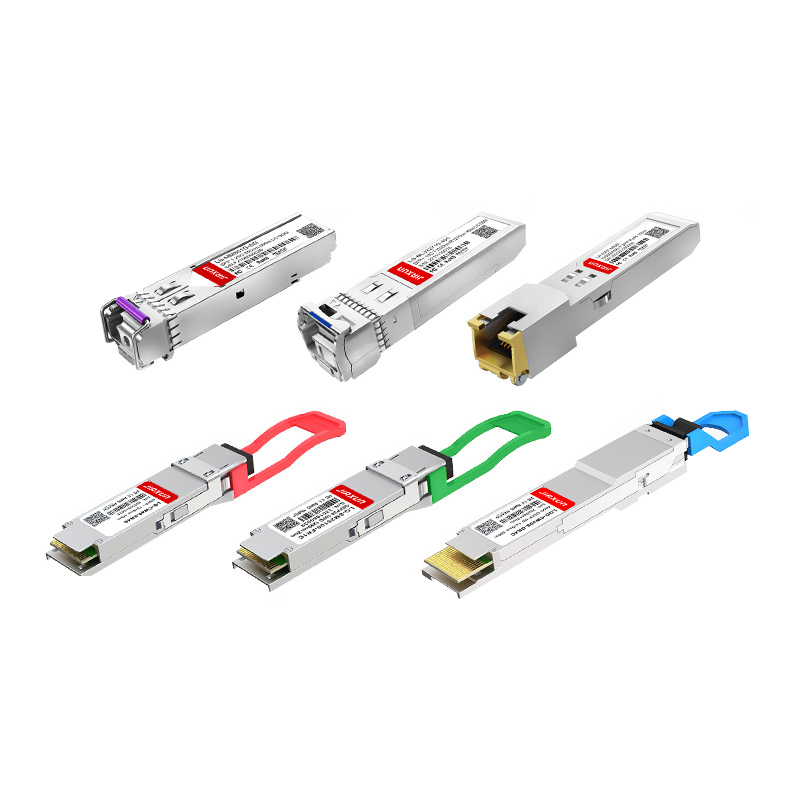
1G SFP Module Compatibility 2025: Works with Cisco 2960/HPE 1950?
For network administrators, IT managers, and anyone responsible for maintaining a stable network, few things are more frustrating than a cryptic error message: %PHY-4-SFP_NOT_SUPPORTED. You’ve sourced a seemingly identical 1G SFP module, plugged it in, and instead of a green link light, you’re met with a dark port and a problem to solve.
The core question, especially for workhorse switches like the Cisco Catalyst 2960 and HPE OfficeConnect 1950, is simple: "Will this third-party 1G SFP module work, or will it be rejected?"
The short answer is: Yes, high-quality, compatibility-tested third-party 1G SFP modules can and do work flawlessly with Cisco 2960 and HPE 1950 series switches. However, achieving this plug-and-play nirvana requires understanding the "why" behind compatibility locks and knowing how to choose the right partner. This definitive 2025 guide will cut through the FUD (Fear, Uncertainty, and Doubt) and give you the technical knowledge and confidence to make the right decision.

Why Do Switches "Lock Down" SFP Modules? The Vendor Strategy
First, it's crucial to understand that compatibility isn't a technical limitation; it's largely a business strategy. OEMs like Cisco and HPE (Aruba) use a system of vendor codes and digital diagnostics monitoring (DDM) data to "validate" modules.
-
The Vendor ID Field: Every SFP module has a small EEPROM memory chip. A specific byte in this memory contains a unique vendor ID (e.g., 0x00000C for Cisco). When the switch boots up or a module is inserted, it can query this ID.
-
OEM "Validation": The switch’s operating system (IOS, Comware, etc.) is programmed to only establish a link with modules that return its expected vendor ID. If the ID is unknown or missing, the switch disables the port.
-
The Profit Motive: OEMs sell their branded modules at a significant premium, often 5-10x the cost of a compatible third-party module. This creates a substantial revenue stream. The compatibility lock is the technological enforcement of this business model.
Thankfully, the industry has responded with a solution: programmed compatibility.
Cracking the Code: How Quality 3rd-Party Modules Achieve Compatibility
Reputable third-party manufacturers don't "hack" or clone modules. They produce high-quality, standards-compliant hardware that is then programmed to communicate effectively with target devices.
-
Standards Compliance: The underlying hardware is built to meet the Multi-Source Agreement (MSA) standards. This governs the physical dimensions, electrical interfaces, and pinouts. A well-made 1G SFP from any vendor is electrically and physically identical to an OEM part.
-
Intelligent Programming: After production and rigorous testing, the module's EEPROM is programmed with the necessary vendor-specific ID and data structures that the target switch (e.g., a Cisco 2960-S) expects to see. This allows it to handshake correctly with the switch’s OS.
-
Full DDM Support: A key sign of a quality module is full support for Digital Diagnostics Monitoring (DDM), also known as SFF-8472. This allows you to monitor real-time parameters like temperature, transceiver voltage, laser bias current, and both transmitted and received optical power via the switch's CLI. This is non-negotiable for professional network management.

Deep Dive: Compatibility for Your Specific Switch Models
Let's get into the specifics of the two models mentioned in our title.
Cisco Catalyst 2960 Series
The Catalyst 2960 is one of the most deployed access-layer switches in history. Its age means it has been thoroughly reverse-engineered.
-
Compatibility Key: Most third-party manufacturers have perfected the coding for Cisco switches. A quality module will typically report the correct Cisco vendor ID and model information.
-
CLI Command to Check: You can verify the module's details on a Cisco switch using:
textshow interfaces transceiver detailsThis command will display the vendor name, part number, and serial number the module is reporting, along with crucial DDM data.
-
Potential Hurdles: Newer versions of IOS/IOS-XE may add more stringent checks. A top-tier provider will constantly update their programming to match these firmware changes.
HPE OfficeConnect 1950 / Aruba 1950 Series
HPE/Aruba switches have a similar, though sometimes more lenient, approach.
-
Compatibility Key: The HPE 1950 series generally accepts a wide range of standard SFP modules. The locks are often less strict than older Cisco systems.
-
CLI Command to Check: On an HPE/Aruba switch (in the CLI), you can use:
display transceiver interface GigabitEthernet x/x/xThis will show the manufacturer, type, and wavelength, confirming the module is being read correctly.
-
The "Unlock" Command: A significant advantage with many HPE/Aruba switches is the existence of a universal command to disable the SFP vendor check. This command, which can be easily found in official HPE documentation or through a quick web search, allows any standard SFP module to work, making compatibility a non-issue. This is a testament to HPE's more open approach.

Beyond Compatibility: Critical Factors for Choosing a 1G SFP Module in 2025
Choosing a module isn't just about fooling a switch. It's about ensuring network performance and longevity.
-
DOM/DDM Support: As mentioned, this is essential for proactive monitoring and troubleshooting link issues. Never buy a "dumb" module without DDM.
-
Form Factor and Type:
-
SFP (1G): The focus of this article.
-
1G SFP+ Module: A note on this term. SFP+ is a form factor designed for 10G speeds. While some SFP+ ports can accept a 1G SFP module with a physical adapter, a "1G SFP+ Module" is a misnomer. Always ensure you are buying a standard 1G SFP module for a 1G port. Trying to use a 10G SFP+ module in a 1G SFP port will not work.
-
-
Fiber Type & Distance:
-
Multimode (SX): Uses OM1 or OM2 fiber (orange) for short distances (up to 550m).
-
Singlemode (LX/LH/EX/ZX): Uses OS1 or OS2 fiber (yellow) for long-haul connections (from 2km up to 160km).
-
-
Wavelength: 850nm (MM), 1310nm (SM/MM), or 1550nm (SM long-haul). Must match on both ends of the link.
-
Certifications: Look for modules that are FCC, CE, and RoHS certified. This indicates compliance with international safety and environmental standards.
-
Lifetime Warranty: The mark of a confident manufacturer. Optics can fail, and a lifetime replacement policy eliminates future cost and hassle.
Case Study: Solving a Real-World Link Loss Issue on a Cisco 2960-S
A client had a 1G LX link between two buildings that would intermittently drop. They were using a low-cost, no-name SFP module.
-
Step 1: I ran
show interfaces transceiver detailson the Cisco switch. The module reported extremely high Rx Power (-32.5 dBm) and a dangerously low Tx Bias Current. -
Analysis: The DDM data was nonsensical and incorrect, a classic sign of a poorly manufactured module with buggy firmware. The actual problem was impossible to diagnose because the diagnostic tool itself was broken.
-
Solution: We replaced both modules with a pair of high-quality, compatibility-guaranteed 1G SFP LX modules from a reputable supplier. The link came up instantly. The
show interfaces transceiver detailscommand now showed accurate, stable values for Tx Power, Rx Power, and Bias Current, all well within acceptable ranges. The link has been stable for over two years.
This case highlights why choosing a module with accurate DDM is just as important as basic compatibility.
Your 2025 Procurement Checklist
Before you buy, ask your supplier these questions:
-
✅ "Are these specifically programmed for [Cisco 2960 / HPE 1950] and guaranteed to work?"
-
✅ "Do they provide full and accurate DDM/DOM data?"
-
✅ "What is the warranty period?" (The correct answer is Lifetime).
-
✅ "Can you provide a sample for testing before a bulk order?" (A confident supplier will say yes).
Conclusion: Confidence Through Quality
The era of being locked into exorbitant OEM optics is over. For legacy but critical hardware like the Cisco 2960 and HPE 1950, the smart choice is a high-quality third-party 1G SFP module from a manufacturer that invests in rigorous compatibility testing, precise programming, and robust hardware design. By focusing on technical excellence rather than vendor lock-in, you can achieve 100% network performance while freeing up your budget for more critical projects.

Partner with a Global Leader: Jiaxun Intelligent Tech
When your network's performance and reliability depend on every component, partnering with a trusted manufacturer is paramount. Jiaxun Intelligent Tech (www.jiaxunzg.com) is a globally recognized enterprise specializing in the research, development, and production of high-speed optical communication components, including a comprehensive range of SFP modules and SFP cages.
Why Designers and Network Engineers Trust Jiaxun:
-
Uncompromising Compatibility: Every Jiaxun 1G SFP module undergoes rigorous testing in real devices, including platforms from Cisco, HPE/Aruba, Juniper, and others. This ensures seamless integration and eliminates the risk of port errors on your valuable switches.
-
Advanced Engineering: Jiaxun's products utilize high-reliability chip solutions from leading manufacturers like Broadcom and feature low-power designs (≤1W for 1G SFPs), reducing thermal load and improving switch stability—a critical factor in high-density installations.
-
Full Standards Compliance: Adhering strictly to IEEE 802.3 and SFP MSA standards, Jiaxun guarantees interoperability and performance. Their modules support full DDM/DOM functionality, providing the accurate, real-time data network operators need to monitor link health.
-
Comprehensive Product Portfolio: Whether you need a standard 1G SFP SX module for a server connection or a long-haul 1G SFP LX for a campus link, Jiaxun offers a solution. Their expertise extends to 10G/25G/100G+ products and a full range of expertly engineered SFP+ cages optimized for thermal management and EMI shielding in demanding data center environments.
For network professionals managing infrastructure built on reliable platforms like the Cisco 2960 and HPE 1950, Jiaxun provides a financially smart and technically superior alternative to OEM optics. Their commitment to quality, backed by a lifetime warranty and world-class support, makes them an ideal partner for ensuring your network remains robust, efficient, and future-proof.
Explore their solutions and learn how they can support your projects at www.jiaxunzg.com.
keywords: 1g sfp module、10g sfp+ module、sfp module optica
10G SFP+ Module Price Guide 2025: Original vs. Compatible (Cost Savings Breakdown)
2025 10G SFP+ Module Compatibility List: Works with Cisco 9300/Huawei S5720?