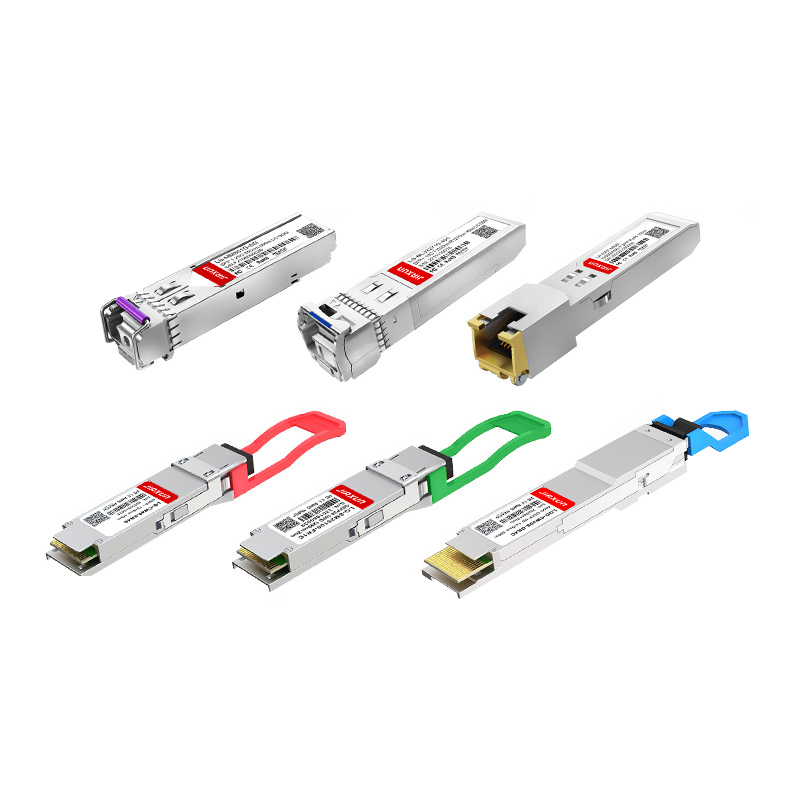
SFP Module Types: A Complete Guide to All SFP Transceivers (2026)
Introduction
With so many SFP modules available, choosing the right type can be confusing.
👉 Selecting the wrong module may cause:
-
Compatibility issues
-
Performance limitations
-
Increased costs
This guide will help you understand all major SFP module types and how to choose the right one.
What Is an SFP Module?
An SFP (Small Form-factor Pluggable) module is a compact, hot-swappable transceiver used in networking equipment.
👉 It enables data transmission between:
-
Switches
-
Routers
-
Servers

Main SFP Module Types
1. Standard SFP (1G)
-
Speed: up to 1 Gbps
-
Used in: legacy and basic networks
Core positioning: Physical layer interface for network devices (switches, routers, network interface cards, etc.), enabling electrical-to-optical/optical-to-electrical signal conversion and adapting to Gigabit Ethernet (1GbE).
Hot-pluggable: Can be directly inserted or removed while the device is powered on without shutting it down.
Compact: Half the size of a GBIC module, increasing port density.
Standardized: Compliant with MSA, SFF, and IEEE standards, ensuring cross-vendor compatibility.
Dual media support: Compatible with optical fibers (multimode/single-mode) and copper cables (Cat5e/6).
SX: 850nm multimode fiber, up to 550 meters.
LX/LH: 1310nm single-mode fiber, up to 10 kilometers.
EX/ZX: Long-haul single-mode fiber, up to 40–80 kilometers.
T: RJ45 electrical port, copper cable up to 100 meters.
-
Speed: up to 10 Gbps
-
Most widely used in modern networks
Form Factor & Compatibility: Same size as SFP, hot-swappable; SFP+ ports are backward compatible with SFP (1G), but not vice versa.
Core Parameters: Speed 10Gbps; wavelengths 850/1310/1550nm; interfaces LC (optical)/RJ45 (electrical); power consumption approx. 1–1.5W; supports DDM digital diagnostics.
Main Types: SR (multi-mode, 300m), LR (single-mode, 10km), ER (single-mode, 40km), ZR (single-mode, 80km), copper DAC/AOC.
Applications: Data centers, enterprise core/convergence layers, server uplinks, 10 Gigabit Ethernet/Fibre Channel.
-
Speed: up to 25 Gbps
-
Designed for high-performance data centers
Core Parameters:
Rate: 25Gbps (25.78Gbps), supporting 25G Ethernet, eCPRI, FC, etc.
Package: 14mm compact size, hot-pluggable, dual LC interface.
Transmission: Multi-mode (850nm) up to 100m; single-mode (1310nm) 10km, (1550nm) 40–80km; copper cable DAC ≤5m.
Low power consumption, equipped with DDM digital diagnostics, compatible with mainstream devices.
Advantages: Lower cost, power consumption and higher density than 40G/100G, and can be combined as 4×25G to form 100G.
Applications: Data centers, 5G fronthaul, HPC, enterprise core networks, 8K video transmission.
4. BiDi SFP (Bidirectional)
👉 Uses single fiber for both TX/RX
Key Principle: Built-in WDM coupler, with transmitting and receiving signals using different wavelengths (commonly 1310nm/1550nm, 1310nm/1490nm); must be used in paired matching (Module A transmits at 1310nm and receives at 1550nm, while Module B operates in reverse).
Structural Features: Only one simplex LC fiber port, saving 50% of fiber resources compared to dual-fiber SFP modules.
Core Advantages: Reduces cabling and expansion costs, conserves fiber cores, and is suitable for scenarios with limited fiber resources.
Typical Applications: 5G fronthaul, FTTH, metropolitan area networks, data center interconnection, and industrial fiber-optic networks.
-
Saves fiber resources
-
Ideal for limited fiber infrastructure
5. CWDM / DWDM SFP
👉 Wavelength multiplexing modules
- Wavelength spacing 20nm, ranging from 1270–1610nm, supporting up to 18 wavelengths
- Uses uncooled lasers, featuring low cost and simple deployment
- Application: Metropolitan area networks, enterprise backbones, short‑to‑medium distance transmission (≤120km)
DWDM SFP (Dense Wavelength Division Multiplexing)
- Wavelength spacing 0.4/0.8nm (50/100GHz), mainly operating in the C‑band, supporting 40–160 wavelengths
- Requires temperature control and wavelength stabilization, offering large capacity and excellent long‑distance performance
- Application: Backbone networks, DCI, ultra‑long‑haul transmission
Common Features
- Hot‑pluggable SFP, LC interface, single‑mode fiber, used for wavelength division multiplexing capacity expansion
-
Long-distance transmission
-
Telecom and backbone networks
6. Copper SFP (RJ45 SFP)
👉 Uses Ethernet cable instead of fiber
Interface and Medium: RJ45 interface, used with Cat5e/6 or higher twisted-pair cables.
Speed and Distance: Up to 100m for Gigabit Ethernet; generally 30m for 10 Gigabit SFP+.
Features: Hot-swappable, low power consumption, compliant with MSA standards.
Advantages: Reuses copper cabling, low cost, flexible deployment.
Application Scenarios: Conversion of switch optical ports to electrical ports, short-distance device interconnection, and computer room jumper connections.
-
Distance: up to 100m
-
Easy deployment
7. AOC (Active Optical Cable)
👉 Integrated cable + module
Definition: Active Optical Cable, a high-speed transmission line integrating optical modules, multimode fibers and active chips, with optoelectronic conversion devices integrated at both ends for plug-and-play use.
Core Structure**: Equipped with VCSEL lasers, PD detectors and signal processing chips at both ends; the middle section consists of multimode fibers (OM3/OM4).
Key Advantages
High Speed: Supports 10G–800G, with a single channel reaching up to 106.25Gbps.
Long Distance: Multimode transmission up to 100 meters, far exceeding DAC copper cables (≤7 meters).
Anti-interference: Optical fiber transmission with no EMI/RFI interference.
Lightweight: Approximately half the volume and a quarter the weight of copper cables, making cabling easier.
Main Applications: Data centers, AI computing power, HPC, storage networks, and high-definition audio and video transmission.
Comparison: Longer distance, higher speed and lighter weight than DAC copper cables; more reliable and simpler to deploy than "optical modules + patch cords".
-
Plug-and-play
-
Used for short-distance high-speed
8. DAC (Direct Attach Cable)
👉 Copper cable with built-in SFP ends
Full Name: Direct Attach Cable.
Structure: Pre-installed high-speed interface modules such as SFP+/QSFP28 at both ends, with copper cable in the middle; the finished product is integrated and non-detachable.
Types:
Passive DAC: No signal amplification circuit, 0.5–7 meters, low power consumption, low cost.
Active DAC: Built-in signal equalization/amplification, 5–15 meters, longer transmission distance.
Advantages: Plug-and-play, low latency, low cost, nearly zero power consumption for passive types.
Limitations: Short transmission distance, weaker anti-interference performance than optical fiber, larger weight and wire diameter.
Applications: High-speed interconnection of servers, switches and storage within racks/short distances in data centers.
-
Low cost
-
Very low latency
SFP Module Types Comparison
| Type | Speed | Distance | Medium | Use Case |
|---|---|---|---|---|
| SFP | 1G | Short/Long | Fiber | Basic networks |
| SFP+ | 10G | Medium | Fiber/DAC | Enterprise |
| SFP28 | 25G | Medium | Fiber | Data center |
| BiDi | 1G–10G | Long | Fiber | Limited fiber |
| CWDM/DWDM | 1G–10G | Very long | Fiber | Telecom |
| Copper SFP | 1G–10G | ≤100m | Copper | Office |
| AOC | 10G+ | Short | Fiber | Rack connections |
| DAC | 10G+ | Short | Copper | Data center |

How to Choose the Right SFP Module
Ask yourself:
-
What speed do you need?
-
What is the transmission distance?
-
Fiber or copper?
-
Compatibility requirements?
👉 Quick guide:
-
Short distance → DAC / Copper
-
Long distance → Fiber
-
High speed → SFP28
Why SFP Cage Matters
All SFP modules rely on SFP cages.
👉 A good cage ensures:
-
Signal integrity
-
EMI shielding
-
Thermal performance
Looking for SFP-Compatible Hardware Solutions?
At JIA XUN, we provide:
✔ SFP / SFP+ / SFP28 cages
✔ High-speed compatible designs
✔ OEM / ODM support
Get Free Samples
📩 Contact us for:
-
Technical specs
-
Samples
-
Custom solutions
FAQ
1. What is the most common SFP type?
SFP+ (10G).
2. Can I use SFP in SFP+ port?
Yes (lower speed).
3. Which SFP is best for data centers?
SFP28 or higher.
Final Thoughts
👉 SFP modules vary by speed, distance, and application
👉 Choosing the right type ensures optimal performance and cost efficiency
10G SFP+ vs 10GBASE-T: Which One Is Better for Your Network?