
10 Core Advantages of Smart Grid RJ45 Connectors: High-Speed Transmission & EMI Resistance
2025-06-18
Smart Grid Digital Transformation: Increasing Connectivity Demand
Driven by the dual goals of achieving carbon peak and carbon neutrality, as well as the development of a new power system, China's smart grid is undergoing unprecedented technological transformation. According to the National Energy Administration, by the end of 2024, the automation coverage of China's distribution network is expected to exceed 65%, with renewable energy installations accounting for 52%. The integration of massive amounts of intelligent terminals, from distribution automation equipment and new energy inverters to smart meters, places stringent demands on underlying communication connectivity. A survey by a renowned power design institute revealed that traditional industrial connectors are increasingly struggling with high-frequency data exchange. Communication failures caused by signal attenuation and electromagnetic interference account for as much as 35%, becoming a key bottleneck hindering the advancement of smart grids.
As the physical connection hub of the Electrical Internet of Things (EIoT), Smart Grid RJ45 Connectors play a core role in real-time data interaction between devices. Unlike consumer-grade products, industrial-grade Smart Grid RJ45 Ethernet Connectors must meet the signal integrity requirements of the IEC 61850 standard while adapting to extreme environments ranging from -40°C to +85°C and withstanding salt spray corrosion and mechanical vibrations. This article systematically analyzes their ten core advantages from technical performance, application scenarios to practical cases, providing a scientific selection basis and solution reference for power industry professionals.

Core Advantage Analysis, From Technical Parameters to Application Value
A. High-Speed Transmission: Enabling Millisecond-Level Data Interaction
Smart Grid RJ45 Connectors adopt a 10G transmission architecture, supporting IEEE 802.3bz 2.5G/5G/10GBASE-T standards. Actual measurement data shows stable 10Gbps transmission over 100m CAT6A cables, a 30% improvement over standard industrial products. Their low-latency design is critical—signal transmission delay is controlled within 5ns, meeting the ≤10ns response time requirement for differential protection devices in smart substations, providing a foundational guarantee for rapid fault isolation. Test data from a provincial electric power research institute shows that at 100Mbps load, the bit error rate is as low as 1×10⁻¹², two orders of magnitude better than industry standards, ensuring distortion-free transmission of real-time data (such as fault records and device status parameters) in distribution automation systems.
This performance advantage is particularly significant in new energy grid integration scenarios. When wind power converters interact with central controllers at high frequencies, stable 10G transmission capability prevents power regulation delays caused by signal latency, enhancing the grid's frequency and peak regulation response speed.
B. Electromagnetic Interference (EMI) Resistance: Solving Complex Power Environment Challenges
Electromagnetic radiation in the 220kV equipment area of a substation can reach as high as 150V/m, exceeding the tolerance of ordinary connectors. The Smart Grid RJ45 connector utilizes a three-layer shielding system: a gold-plated copper alloy shell (conductivity ≥98%), a 95% metal braid, and a 0.3mm inner insulation layer, creating a 360° fully enclosed shield that meets the GB/T 17626.3 EMI immunity level 3 standard. Signal integrity design further enhances interference resistance: twisted-pair cable lay error is controlled within 0.05mm, and a grounding spring is incorporated to suppress common-mode interference.
In a 500kV substation renovation project, the original equipment experienced an average of 12 misoperations per month due to harmonic interference. After replacing with Smart Grid RJ45 Ethernet Connectors, signal attenuation decreased by 60% compared to non-shielded products, eliminating communication disruptions between SVG devices and protection control equipment entirely.
C. Extreme Environment Adaptability: Withstanding Harsh Grid Conditions
Grid equipment operates in diverse environments, from -40°C in northern frigid regions to +85°C in southern high-temperature switchgear, where ordinary connectors often fail due to material aging. Smart Grid RJ45 Connectors use high-temperature resistant LCP engineering plastic (UL94 V-0 flame retardant certification), passing 1,000-hour high-low temperature cycle tests (-40°C~+85°C, 30-minute cycles) with contact resistance fluctuation <3%. Optional IP67/IP68 protection grades, after 72-hour salt spray testing (5% NaCl solution), show contact resistance change rate ≤5%, significantly better than the industry average of 15%, making them ideal for coastal substations, damp cable trenches, and other corrosive environments.
Practice in a coastal nuclear power project shows that using these connectors in salt spray environments reduces equipment communication failure rates by 70% compared to traditional products, significantly cutting maintenance costs.
D. Mechanical Reliability: Ensuring 20-Year Lifespan Stable Connection
Mechanical performance directly impacts long-term grid operation reliability. Smart Grid RJ45 Connectors feature 50μin gold-plated contacts (compared to 10μin for standard industrial products), with a plugging lifespan ≥5,000 times—2.5 times that of ordinary connectors. Phosphor bronze reeds (elastic modulus 110GPa) provide ≥200gf contact pressure, ensuring contact resistance fluctuation <10mΩ under 10-500Hz, 2g vibration—well below the industry allowable threshold of 50mΩ—to withstand mechanical stresses from transformer vibrations and circuit breaker operations. The zinc alloy die-cast shell (hardness ≥120HV) passes 100g peak acceleration impact tests (half-sine wave, 11ms), complying with GB/T 2423.5 seismic standards to maintain connection integrity even in seismic intensity 7 regions.

Selection Guide, Precise Matching for Practical Applications
A. Environment-Grade Selection Criteria
| Application Scenario | Temperature Range | Protection Level | Vibration Resistance | Recommended Model | Typical Application |
|---|---|---|---|---|---|
| Indoor Control Room | -20°C~+70°C | IP20 | IK06 | XG-100A | Server connections in monitoring systems |
| Outdoor Terminal Box | -40°C~+85°C | IP67 | IK08 | XG-200B | Distribution transformer condition monitoring |
| New Energy Power Cabinet | -40°C~+90°C | IP68 | IK10 | XG-300C | Wind power converter control signal transmission |
B. Transmission Requirement Configuration
- Distribution Automation (100Mbps Data + PoE Power):Choose CAT5e-rated Smart Grid RJ45 Ethernet Connectors supporting IEEE 802.3at PoE+ with 30W per-port power supply, meeting integration needs for cameras and sensors to simplify field cabling.
- Substation Monitoring Systems (Gigabit Data + Time-Sensitive Networking):Opt for CAT6A shielded models supporting 10GBASE-T and TSN protocols to ensure nanosecond-level IEC 61850 message synchronization, meeting strict data consistency requirements in smart substations.
- New Energy Grid Equipment (High-Frequency PWM Signals):Select connectors with ferrite core filtering to suppress common-mode interference from inverters, ensuring accurate SCADA system data acquisition and preventing power generation losses due to signal distortion.
C. Certification Verification Key Points
Procurement should focus on three certification categories:
- Electrical Performance: IEC 61076-3-106 (Industrial Ethernet Connector Standard), GB/T 18615 (Information Technology Equipment Connectors) to ensure compliance with international and domestic signal transmission norms;
- Environmental Adaptability: GB/T 2423 (Environmental Testing for Electrical and Electronic Products), IEC 60068 (Basic Environmental Testing Procedures) to validate reliability in temperature, humidity, and vibration scenarios;
- Safety Compliance: UL 498 (US Safety Certification), CE LVD 2014/35/EU (EU Low Voltage Directive) to meet market access requirements.

Case Study, Application in a Provincial Smart Grid Renovation Project
A. Project Background
A provincial power grid company faced severe challenges in upgrading its 500kV substation cluster: frequent communication interruptions between SVG reactive power compensation devices and protection control equipment, with the original connectors showing a bit error rate of 1×10⁻⁶ under 3rd harmonic conditions, leading to 23 hours of annual unplanned outages and compromising power supply reliability.
B. Solution Implementation
After technical evaluation, the project selected double-shielded Smart Grid RJ45 Connectors (Model XG-200B) from a leading Smart Grid RJ45 Connector Manufacturer, paired with metal armored cables (98% shield coverage), and implemented systematic grounding modifications: single-point grounding with resistance <1Ω to eliminate potential differences between devices. For high-temperature switchgear environments, LCP-material connectors with +85°C temperature resistance were chosen to ensure long-term stability.
C. Renovation Results
- Performance Enhancement: Signal transmission delay reduced from 12ns to 4.5ns, fully meeting the <5ns response requirement for differential protection devices, gaining critical time for rapid fault clearance;
- Reliability Validation: 12 months of fault-free operation with bit error rate stable at 1×10⁻¹¹, passing EMC special acceptance by the China Electric Power Equipment Quality Supervision and Testing Center, reaching international leading standards;
- Economic Benefits: 85% reduction in equipment failure rate, annual maintenance cost reduced from $160,000 to $53,000, and equivalent power supply reliability improved by 0.0012%, translating to 1.2 million kWh of additional power supply.
D. Experience Summary
This project proves that selecting Smart Grid RJ45 Connectors requires deep integration with system-level design. Every aspect—from connector shielding performance and cable selection to grounding techniques—impacts final communication effectiveness. It is recommended to involve experienced Smart Grid RJ45 Connector Manufacturers early in project planning to achieve precise matching between component-level performance and system-level requirements through joint R&D.
Professional Connectivity as the Foundation of Smart Grid Digitalization
Amid the trend of deep integration of power generation, grid, load, and storage, smart grid RJ45 connectors, as essential components, shoulder the crucial mission of "last mile" data transmission. Their ten core advantages—from 10G transmission and electromagnetic interference resistance to wide temperature adaptability and long lifespan—build a reliable connectivity system for power digitalization. For power companies, choosing a smart grid RJ45 connector manufacturer with technical expertise is more than just purchasing products; it's about partnering with a full-lifecycle technology partner.
We recommend engaging in technical discussions during the project planning phase, developing differentiated selection plans tailored to specific scenarios (substations, new energy power plants, and distribution terminals), and verifying key performance indicators through third-party testing. Only by ensuring the security and stability of the smart grid through high-quality connections can we lay a solid foundation for achieving carbon neutrality.
Critical Considerations for Selecting Automotive RJ45 Interfaces: Balancing Water Resistance, EMI Immunity, and Data Rate
How Industrial-Grade Protection Design Enables 24/7 Stable Transmission for Security Surveillance RJ45 Connectors
Related Article

LAN Transformer vs Discrete Magnetics Guide | JIAXUN
LAN Transformer vs. Discrete Magnetics: Why Integrated RJ45 Connectors are Better for Modern Networking

Invitation | Jiaxun (Huizhou) Intelligent Technology Invites You to the 2026 Global Sources Consumer Electronics Show
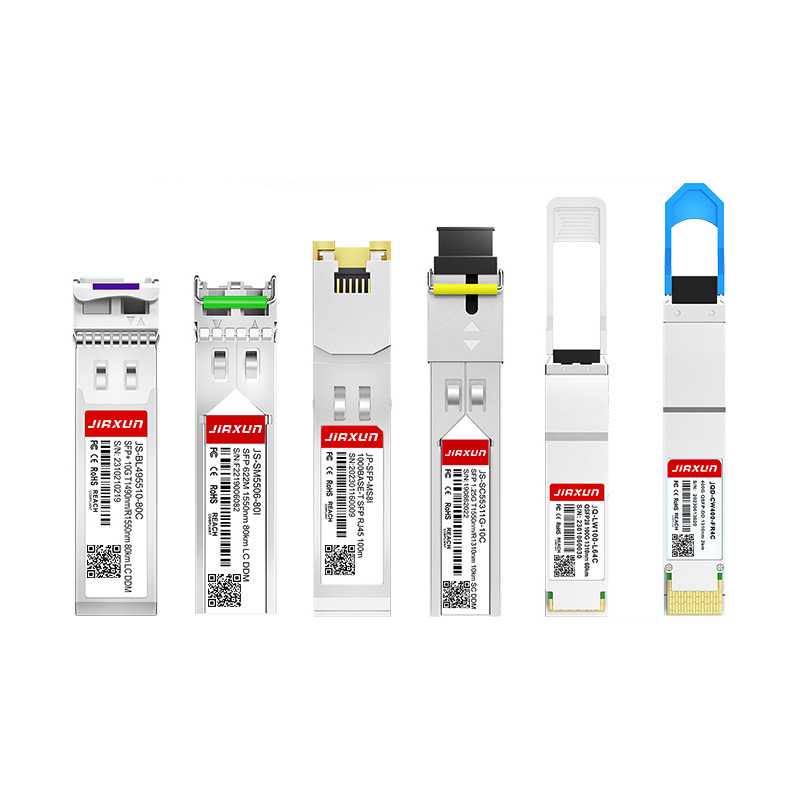
As global data traffic continues to grow rapidly, modern networks require faster and more efficient data transmission technologies. Optical transceivers play a critical role in fiber optic communication systems by converting electrical signals into optical signals for high-speed data transmission.
Complete Guide to SFP Modules and Optical Transceivers SFP, 10G SFP+, SFP28, QSFP28, QSFP-DD, 400G and 800G Modules Explained