
Aerospace RJ45 Connectors: Unveiling Six Core Advantages as the 'Lifeblood' of Aerospace Equipment
2025-06-19
The Critical Role of Connectors in Aerospace Safety
In the aerospace industry, even millimeter-scale connection failures can trigger systemic risks. Public data from the National Aeronautics and Space Administration (NASA) indicates that 70% of aerospace electronics failures stem from connector system anomalies. In one notable case, a low-Earth orbit (LEO) satellite experienced a 47-minute communications outage due to a sudden fluctuation in the contact resistance of its connector, directly impacting ground-based (TT&C) operations. These incidents highlight the critical role of aerospace RJ45 connectors—as core nodes for signal and power transmission, they support mission-critical functions such as inter-satellite communications, payload control, and environmental monitoring.
Unlike commercial-grade connectors, aerospace RJ45 connectors must comply with stringent standards such as GJB 599 and MIL-DTL-38999. Their design incorporates specialized materials, structural innovations, and rigorous reliability testing. For example, in manned space missions, these connectors not only transmit control signals but also ensure the airtightness of life support systems, earning them the reputation of being the "lifeblood of aerospace."

Core Advantages: Six Technical Features Defining Aerospace-Grade Reliability
1. Extreme Environmental Adaptability: Material Innovations for Harsh Conditions
Aerospace missions demand operation across a 400℃ temperature span, from -200℃ in deep space to +200℃ near rocket engines. Aerospace RJ45 network connectors achieve breakthroughs through advanced materials: titanium alloy (Ti-6Al-4V) housings with nano-ceramic coatings, certified by NASA EEE-INST-002 for continuous operation between -200℃ and +125℃. During the Chang'e-5 lunar mission, such connectors enabled stable data transmission from the moon's frigid far side, demonstrating resilience in extreme cold.
Vibration and shock resistance are critical during rocket launches. A domestically developed model utilizes a "titanium alloy framework + encapsulated silicone rubber damping layer", withstanding 10-2000Hz full-band vibration (sinusoidal acceleration ≥15g) and 1000g instantaneous shocks—ensuring signal integrity in high-frequency engine environments.
2. Signal Integrity Assurance: Meeting High-Speed, High-Frequency Demands
As aerospace systems evolve toward intelligence and integration, aerospace RJ45 network interfaces must support signals up to 28GHz and beyond. An air-dielectric insulation structure paired with 50μin gold-plated contacts (three times thicker than industrial standards) achieves ≤0.3dB insertion loss at 28GHz, reducing signal loss by 60% compared to conventional solutions. This enables reliable preprocessing for inter-satellite laser communication terminals, ensuring <10⁻¹² bit error rate at 1.25Gbps.
For EMI protection, a three-layer shielding design—metal casing, silver-plated braided mesh, and conductive coating—forms a robust barrier. In human spaceflight, this mitigates onboard electromagnetic noise, securing real-time communication between flight control systems and ground stations.
3. Longevity & Stability: Sustaining Decade-Long Missions
With typical orbital lifespans of 5-15 years, aerospace connectors require exceptional mechanical stability. Leading products endure over 5,000 mating cycles (vs. 1,000 for industrial models) with contact resistance fluctuations ≤5mΩ. Airtight designs rated IP68 (24-hour immersion at 10m depth) and 10⁻⁹mbar·L/s leak rate safeguard oxygen transmission in spacecraft life support systems—proven by the Shenzhou series, which recorded zero connector failures in 10+ years of operation.
4. Lightweight Integration: Optimizing Aerospace Payloads
Every 1kg payload reduction saves ~$14,000 in launch costs. Aerospace RJ45 connectors deliver dual innovation: magnesium-lithium alloy housings (1.3g/cm³ density, 40% lighter than aluminum) are used in SpaceX Starlink satellites, achieving 12kg/satellite weight savings; a compact 24-pin design (30% smaller volume) supports hybrid power-signal-fiber transmission , ideal for high-density satellite payloads.
5. Radiation Resistance: Shielding Against Cosmic Hazards
Geosynchronous orbit exposes equipment to 5×10⁴Gy(Si) annual ionizing radiation. Aerospace connectors employ boron-aluminum whisker-reinforced nylon insulators and lead-alloy shields, withstanding 10⁵Gy(Si)—twice the operational requirement. Single-event upset (SEU) testing shows a threshold >50MeV·cm²/mg, minimizing high-energy particle interference for deep-space probes.
6. Intelligent Diagnostics: Enabling Predictive Maintenance
Equipped with MEMS sensors and IEEE 1149.1 (JTAG) interfaces, next-gen connectors monitor real-time temperature, humidity, and contact resistance. In a rocket control system application, this technology detected a terminal loosening fault 72 hours in advance, shifting from reactive to predictive maintenance. Nano-silver coating technology further auto-repairs minor oxidation, enhancing system fault tolerance.

Application Showcase: Full Spectrum of Aerospace Missions
In launch vehicles, aerospace RJ45 connectors handle timing-critical signals between core stages and boosters, with latency errors <1μs. China's Long March 5B rocket relies on domestically produced models that have supported 220+ flawless launches, setting a standard for next-gen launch systems.
For satellite communications, BeiDou-3 satellites utilize aerospace RJ45 network interfaces to enable 1.25Gbps inter-satellite links, critical for global navigation accuracy. In human spaceflight, connectors in the umbilical cables between Shenzhou spacecraft and Tiangong Station must ensure both airtightness (for oxygen transfer) and signal synchronization—direct safeguards for crew life support.
Deep-space missions pose ultimate challenges: the Tianwen-1 Mars rover's connectors withstood 2,000 hours of thermal vacuum cycling (-140℃ to +80℃), reliably transmitting multi-sensor data from the Martian surface and cementing China's planetary exploration capabilities.

Industry Impact & Future Trends: Redefining Aerospace Connectivity Standards
The global aerospace connector market is experiencing accelerated localization. Chinese firms like CASIC and AVIC Optoelectronics have increased their market share from 15% (2015) to 45% (2024), breaking long-term dominance by L3Harris and TE Connectivity. This shift enhances supply chain security while reducing mission costs.
Technological frontiers include 0.1-1THz connectors for 6G and terahertz remote sensing, with prototypes in development; 3D-printed monolithic housings promise 20% weight reduction and 30% cost savings, targeting 2026 deployment. Standardization efforts are underway, with China drafting the General Specification for Aerospace RJ45 Connectors (scheduled for 2026 release), aligning testing methodologies and performance metrics globally.
Conclusion: Small Components, Big Mission
From LEO to interplanetary space, aerospace RJ45 connectors form the "neural network" of aerospace systems with micrometer precision. Their six core advantages represent more than technical excellence—they are critical enablers for cost-efficient commercial spaceflight. As global aerospace enters a new era of high-frequency launches, these "small but sophisticated" components symbolize a nation's advanced manufacturing prowess—connecting not just devices, but humanity's boundless cosmic ambitions.
Exploring the Latest LAN Transformer Solutions for Efficient Power Distribution
Critical Considerations for Selecting Automotive RJ45 Interfaces: Balancing Water Resistance, EMI Immunity, and Data Rate
Related Article

LAN Transformer vs Discrete Magnetics Guide | JIAXUN
LAN Transformer vs. Discrete Magnetics: Why Integrated RJ45 Connectors are Better for Modern Networking

Invitation | Jiaxun (Huizhou) Intelligent Technology Invites You to the 2026 Global Sources Consumer Electronics Show
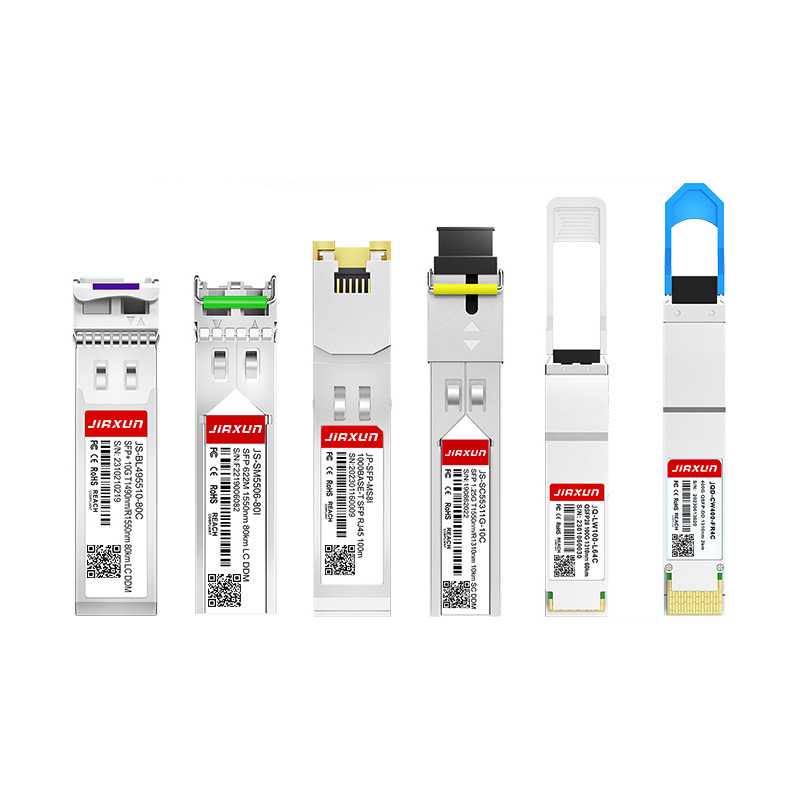
As global data traffic continues to grow rapidly, modern networks require faster and more efficient data transmission technologies. Optical transceivers play a critical role in fiber optic communication systems by converting electrical signals into optical signals for high-speed data transmission.
Complete Guide to SFP Modules and Optical Transceivers SFP, 10G SFP+, SFP28, QSFP28, QSFP-DD, 400G and 800G Modules Explained