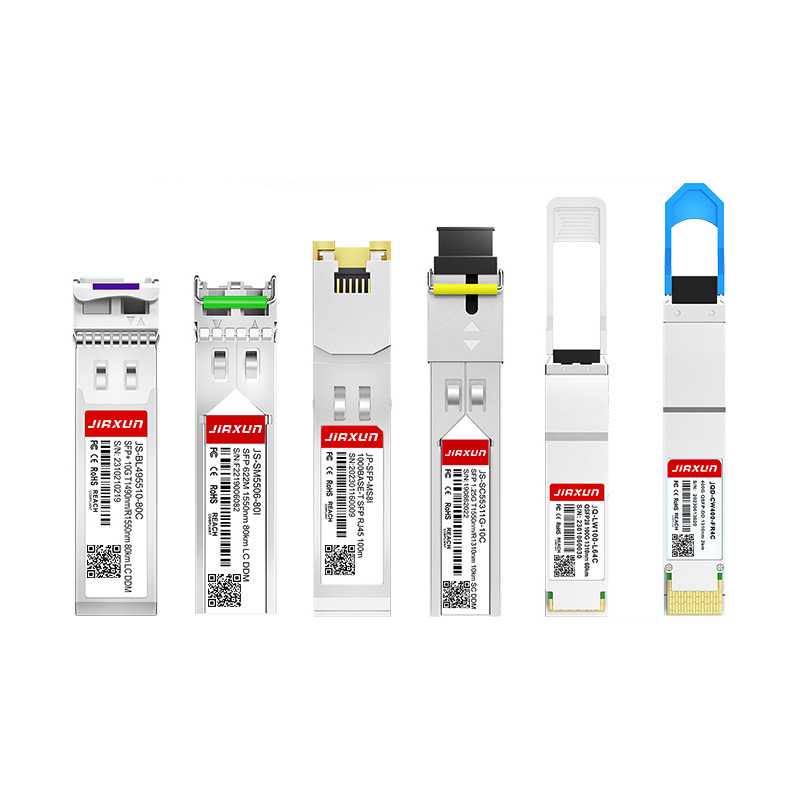
Fiber Optic Modules- Core Technology Driving the Digital Future and Market Insights
Chapter 1: Technical Definition and Core Functions of Fiber Optic Modules
A fiber optic module (optical transceiver) is an integrated device that converts electrical signals to optical signals and vice versa. It comprises lasers, photodetectors, driver circuits, and optical interfaces, with core functionalities including:
-
Electro-Optical Conversion: Transforming electrical signals to light (transmitter) or light to electrical signals (receiver).
-
Protocol Compliance: Supporting Ethernet, Fiber Channel (FC), and other communication standards.
-
Rate Adaptability: Covering speeds from 1Gbps to 800Gbps to meet diverse bandwidth demands.
Based on form factors, fiber optic modules include SFP optical modules (Small Form-factor Pluggable), QSFP (Quad SFP), and OSFP (Octal SFP). Among these, SFP optical modules dominate enterprise networks due to their compact size (20mm×10mm), hot-swappable design, and low power consumption (<1W).

Chapter 2: Diverse Applications and Market Demand for Optical Modules
Fiber optic modules are essential across telecommunications, data centers, and industrial automation:
-
5G Base Stations: 25G/50G optical modules enable low-latency (<1μs) signal transmission for fronthaul (FH) and midhaul (MH) networks.
-
Hyperscale Data Centers: 400G/800G modules power AI clusters and cloud services, reducing per-rack power consumption by 30%.
-
Smart Manufacturing: Industrial-grade modules (-40℃ to 85℃ operating range) enhance EMI resistance in PLCs and machine vision systems by 50%.
Per LightCounting, the global optical module market will exceed $20 billion by 2025, with Chinese suppliers capturing over 40% share. SFP optical modules remain dominant in SME markets due to compatibility and cost-effectiveness.

Chapter 3: Competitive Advantages of Fiber Optic Modules
Compared to traditional copper cables, fiber optic modules excel in three areas:
-
Ultra-High Bandwidth: Single-mode fiber supports transmission distances up to 80km (100G LR4), far exceeding copper’s 100m limit.
-
Immunity to Interference: Optical signals resist electromagnetic noise, ensuring data integrity in finance and healthcare.
-
Energy Efficiency: 100G modules consume 60% less power than copper alternatives, aligning with global decarbonization goals.
SFP optical modules further enhance competitiveness through:
-
Plug-and-Play Design: Enables hot-swapping to minimize network downtime.
-
Multi-Rate Compatibility: Adaptive 10G/25G switching via Digital Diagnostic Monitoring (DDM).
-
Cost Leadership: Chinese optical module manufacturers leverage localized chip sourcing, pricing SFP modules 30% below Western counterparts.

Chapter 4: Manufacturing Processes and Quality Control
Fiber optic module production integrates precision optics and semiconductor technologies:
-
TO-CAN Packaging: Laser chips (DFB/EML) and lenses are hermetically sealed in metal housings, achieving leak rates of 10⁻⁸ Pa·m³/s.
-
COB Bonding: Gold wire bonding connects driver ICs to PCBs with ±1μm alignment accuracy.
-
Optical Alignment: Six-axis automated alignment systems optimize fiber-to-chip coupling efficiency (>95%).
-
Aging Tests: Modules undergo 500-hour stress tests at 85°C to eliminate early failures.
To enhance yield rates, top manufacturers deploy AI-powered optical inspection systems, detecting issues like beam misalignment or solder voids, reducing defect rates to <0.05%. Chinese optical module producers, through vertically integrated TOSA/ROSA (Transmitter/Receiver Optical Sub-Assembly) production lines, slash lead times to 15 days, strengthening their global supply chain influence.
Conclusion
From gigabit to terabit-era networks, fiber optic modules remain the backbone of digital infrastructure. Emerging technologies like CPO (Co-Packaged Optics) and LPO (Linear Pluggable Optics) will redefine industry standards. Chinese manufacturers, with agile production and R&D innovations, are poised to lead the 800G/1.6T era, delivering high-density, low-power solutions for global connectivity challenges.
SFP Optical Modules- Core Engine of High-Speed Network Interconnectivity and Market Opportunities
Ethernet Transformer Wholesale- Core Component Analysis and Supply Chain Synergy
Related Article