
How Industrial-Grade Protection Design Enables 24/7 Stable Transmission for Security Surveillance RJ45 Connectors
2025-06-18
Key Challenges in Security Surveillance Transmission: Why Stable Connections Are Critical
The reliability of the transmission layer directly impacts the effectiveness of security surveillance systems. According to the "2024 Security Industry White Paper," outdoor surveillance equipment experiences an average of 12.7 failures per 100 devices per year due to environmental factors such as moisture intrusion and thermal expansion in extreme climates. For example, one automotive factory's production line monitoring system suffered signal loss due to electromagnetic interference, resulting in $230,000 in monthly quality tracing costs. In smart city projects, signal crosstalk within densely deployed camera arrays caused license plate recognition delays exceeding 500 milliseconds, impacting operational efficiency.
Mission-critical environments such as financial institutions and transportation hubs require "zero downtime," with some data centers requiring less than 15 minutes of system downtime per year. Under reactive maintenance models, maintenance costs account for over 60% of system lifecycle expenses. Forward-thinking integrators are prioritizing proactive reliability by selecting industrial-grade connectors, shifting the focus from post-failure repair to preventative protection for improved lifecycle management.
Mission-critical environments such as financial institutions and transportation hubs require "zero downtime," with some data centers requiring less than 15 minutes of system downtime per year. Under reactive maintenance models, maintenance costs account for over 60% of system lifecycle expenses. Forward-thinking integrators are prioritizing proactive reliability by selecting industrial-grade connectors, shifting the focus from post-failure repair to preventative protection for improved lifecycle management.

The Technical Framework of Industrial-Grade Protection: Five Core Modules
1. Enclosure Protection System: Building a Physical Defense
Material selection balances mechanical strength and environmental resilience. PA66+GF30 nylon, with UL94V-0 fire rating and operational stability at -40°C, is ideal for outdoor use, while zinc alloy die-casting (tensile strength ≥600MPa) suits high-vibration scenarios like mobile surveillance. IP67/IP68 ratings are achieved through food-grade silicone gaskets and dual-surface sealing, ensuring 24-hour submersion resistance. A zinc-nickel alloy plating (thickness ≥8μm) passes 96-hour salt spray testing, providing 10+ years of corrosion resistance in coastal areas.
2. Enhanced Electrical Connection Design: Purity in Signal Transmission
Phosphor bronze terminals with 50μ" gold-nickel plating maintain contact resistance ≤50mΩ, reducing transmission loss by 30% compared to tin-plated alternatives. IDC terminals with serrated crimping and stranded conductor layering pass IK08 impact tests (10J energy without contact failure). Modified PPE insulation materials offer a -40°C to +85°C temperature range and volume resistivity ≥10¹⁶Ω·cm, preventing leakage-induced signal distortion.
3. Anti-Interference Technology Matrix: Conquering Electromagnetic Complexity
Full-metal shielding with 360° grounding boosts EMC compliance from 60% to 98%, achieving common-mode rejection ratio >60dB. Cat.6A connectors with controlled-pair layering (±0.1mm tolerance) suppress NEXT to <-50dB at 10Gbps, maintaining bit error rate <10⁻¹². Surge protection with integrated TVS diodes withstands 6kV common-mode and 4kV differential-mode strikes, reducing lightning damage by 85%.
4. Environmental Adaptation Optimization: All-Scenario Performance
Patented spring-loaded contact designs dynamically compensate for thermal expansion (-35°C to +70°C), maintaining stable contact pressure. Nano-coating technology ensures <5% insulation resistance degradation after 1,000 hours at 95% humidity, triple the industry standard. Honeycomb stainless-steel filters (5μm pore size) block dust while minimizing airflow resistance (drag coefficient 0.3), critical for long-term outdoor reliability.

From Lab to Field: The Real-World Validation System
1. Multi-Dimensional Testing Standards: Data-Driven Reliability
Rigorous testing includes 1,000-hour aging at 85°C/85%RH (contact resistance change ≤10%) and 5,000-cycle mating durability (failure rate <0.1%). Transmission tests show industrial-grade connectors achieve 0.003% packet loss over 200m Cat.6 cables—1/17th that of commercial alternatives—suitable for uncompressed 8K video.
2. Application Scenario Case Studies: Proven Performance
- Coastal Port Security: 500 deployed connectors survived 3 years of high salinity (30‰+) with zero corrosion-related failures, extending replacement cycles by 2.3x.
- Wind Farm Monitoring: -35°C cold starts achieved 100% success rate versus 40% failure with standard connectors, thanks to low-temperature toughness enhancements.
- Substation Modernization: EMI-resistant connectors reduced false alarms from 18 to 0.5 daily, an 83% improvement, earning client-specific technical certification.
3. Manufacturing Process Control: End-to-End Quality Assurance
Automated production uses CCD vision systems to maintain crimping precision (±0.05mm) and 100% Kelvin Four lines testing for <0.008% leakage—10x better than industry norms. ISO/TS16949-compliant traceability provides 10-year access to batch testing data, essential for high-stakes projects.

Translating Technology into Value: The Cost-Benefit Model
1. Tangible Cost Savings: Short-Term Investment, Long-Term Gain
Industrial-grade reliability cuts average troubleshooting time from 4 to 1.2 hours per incident, delivering 70% annual operation and maintenance cost savings. With 5-8 year lifespans (vs. 2-3 years for standard connectors), total cost of ownership decreases by 45%. Avoiding a single critical downtime event in finance or transportation can save hundreds of thousands, outweighing initial cost premiums.
2. Intangible Value Enhancement: System-Level Performance Upgrade
A smart campus saw video Frame drop rate drop from 15% to 1.2%, improving AI analytics effectiveness by 98%. Critical signal accuracy reached 99.999%, eliminating security blind spots. For integrators, IATF16949-certified products provide 10-15 bid Add points in government/military tenders, significantly boosting competitiveness.
3. Selection Guide: Aligning with Application Requirements
- Environment: Prioritize temperature range (-40°C to +85°C), protection rating (IP68 for wet environments), and shielding efficiency (≥90dB for EMI zones).
- Transmission Speed: Choose Cat.5e for 100Mbps, Cat.6 for 1Gbps, and Cat.6A+ for 8K/AI systems.
- Vendor Criteria: Partner with manufacturers holding IATF16949, UL/CUL certifications, and third-party test reports to ensure compliance with international standards.
Conclusion: Redefining Reliability in Security Connectivity
As smart security evolves toward AI and ultra-high definition, transmission stability has become a foundational requirement. Industrial-grade security surveillance RJ45 connectors deliver three-dimensional protection—physical, electrical, and environmental—ensuring uninterrupted operation. This is more than a component choice; it's a strategic investment in system reliability, maintenance efficiency, and project competitiveness. With 8K and edge computing on the horizon, industrial connectivity will serve as the critical infrastructure driving the security industry from "functional" to "future-proof."
10 Core Advantages of Smart Grid RJ45 Connectors: High-Speed Transmission & EMI Resistance
Securing Patient Safety: The Critical Role of Medical-Grade RJ45 Ethernet Jacks in Healthcare
Related Article

LAN Transformer vs Discrete Magnetics Guide | JIAXUN
LAN Transformer vs. Discrete Magnetics: Why Integrated RJ45 Connectors are Better for Modern Networking

Invitation | Jiaxun (Huizhou) Intelligent Technology Invites You to the 2026 Global Sources Consumer Electronics Show
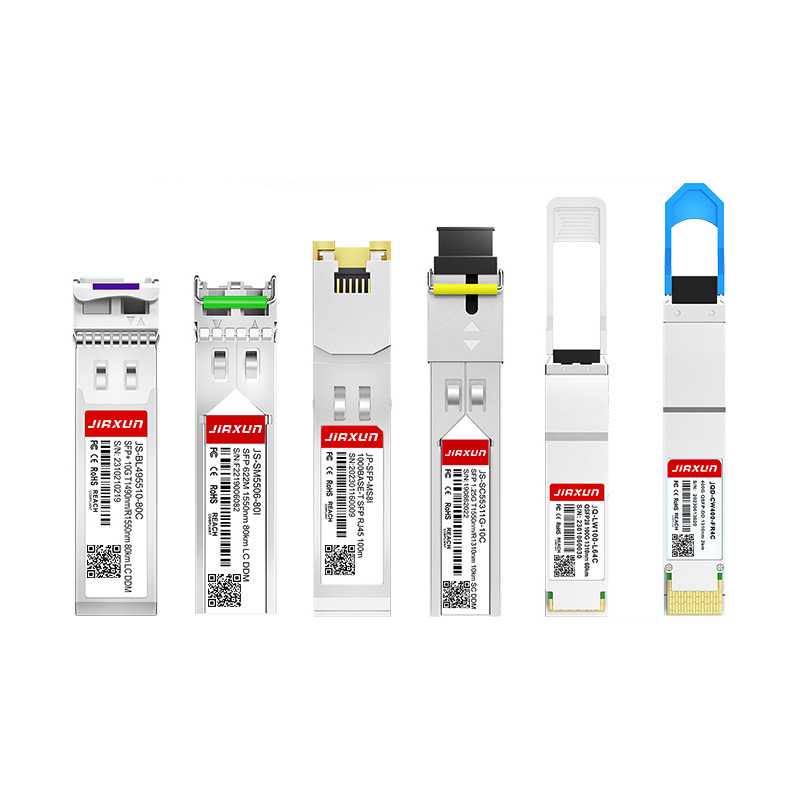
As global data traffic continues to grow rapidly, modern networks require faster and more efficient data transmission technologies. Optical transceivers play a critical role in fiber optic communication systems by converting electrical signals into optical signals for high-speed data transmission.
Complete Guide to SFP Modules and Optical Transceivers SFP, 10G SFP+, SFP28, QSFP28, QSFP-DD, 400G and 800G Modules Explained