Master RJ45 Connector Pinouts: The Ultimate Guide to T568A vs T568B Wiring
In the backbone of modern networking, the humble RJ45 connector is the unsung hero. Whether you’re deploying a home office setup or an enterprise data center, understanding T568A and T568B wiring standards is non-negotiable for reliable Ethernet connectivity. This guide demystifies these critical standards, their applications, and how to avoid costly installation errors.
1. The Anatomy of an RJ45 Connector
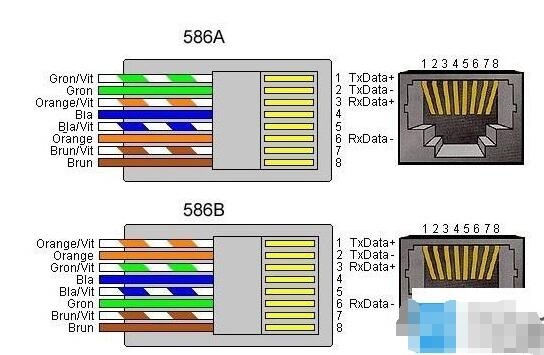
The RJ45 connector (officially 8P8C—8 Positions, 8 Contacts) features eight gold-plated pins that terminate twisted-pair Ethernet cables. When the metal contacts face you:
-
Pin 1 is leftmost, Pin 8 is rightmost.
-
Each pin pairs with a wire color under the T568A or T568B standard.
-
Proper termination ensures minimal electromagnetic interference (EMI), as twisting wire pairs cancels noise2.
Critical Insight: Misaligned pinouts cause connectivity drops, speed throttling, or complete link failure.
2. T568A vs T568B: Decoding the Standards
T568B Wiring (Most Common in North America)
| Pin | Wire Color |
|---|---|
| 1 | White/Orange |
| 2 | Orange |
| 3 | White/Green |
| 4 | Blue |
| 5 | White/Blue |
| 6 | Green |
| 7 | White/Brown |
| 8 | Brown |
T568A Wiring (Common in Government/Residential Networks)
| Pin | Wire Color |
|---|---|
| 1 | White/Green |
| 2 | Green |
| 3 | White/Orange |
| 4 | Blue |
| 5 | White/Blue |
| 6 | Orange |
| 7 | White/Brown |
| 8 | Brown |
Key Difference: T568A swaps the positions of the green and orange pairs. Pins 4, 5, 7, and 8 remain identical in both standards2.
3. Straight-Through vs Crossover Cables: When to Use Which
-
Straight-Through Cable:
-
Both ends use T568A OR T568B.
-
Connects dissimilar devices (e.g., computer to switch, router to hub)2.
-
-
Crossover Cable:
-
One end T568A, the other T568B.
-
Links like devices (e.g., computer to computer, switch to switch).
-
Modern Note: Auto-MDIX (Automatic Medium-Dependent Interface Crossover) in contemporary switches/router ports often eliminates crossover needs. Verify device specs first2.

4. Why the T568B Dominance? Practical Implications
-
Backward Compatibility: T568B aligns with legacy telephone wiring (AT&T’s 258A), easing hybrid installations.
-
PoE Optimization: Pins 4–5 (blue pair) and 7–8 (brown pair) deliver power in PoE standards (IEEE 802.3af/at). T568B’s consistent pinout simplifies power routing24.
-
Global Consistency: While T568A is mandated in some EU countries, T568B remains the de facto global standard for commercial networks.
5. Step-by-Step: Crimping a Flawless RJ45 Connector
-
Strip & Untwist: Expose 1.5 inches of cable; untwist pairs minimally to avoid EMI vulnerability.
-
Align Wires: Arrange wires in T568A/B sequence. Trim ends evenly.
-
Insert into Jacket: Push wires into RJ45 until contacts pierce insulation.
-
Crimp Securely: Use a ratcheting tool; tug-test the cable.
Pro Tips:
-
Use CAT6-rated connectors for Gigabit+ speeds.
-
Test cables with a LAN tester to detect miswires or shorts.
-
Maximum distance: 100 meters (add repeaters for longer runs)2.
6. Common Pitfalls & How to Avoid Them
-
Mixed Standards in One Cable: Causes signal reversal. Stick to one standard per installation.
-
Split Pairs: Accidentally separating twisted pairs (e.g., pairing Pin 3 with Pin 4) induces crosstalk. Use a continuity tester.
-
Inadequate Stripping: Exposing >0.5 inches of untwisted wire invites interference.
Case Study: A data center reported 40% packet loss due to T568A/T568B hybrids in a single rack. Re-standardizing to T568B resolved latency4.
7. Future-Proofing Your Network
While T568A/B support up to 10 Gbps (CAT6a), emerging standards like CAT8 (40 Gbps) demand precision. Best practices:
-
Document Standards: Label patch panels with the wiring scheme.
-
Prioritize Shielding: Use FTP (Foiled Twisted Pair) cables in high-noise environments.
-
Automate Testing: Deploy cable certifiers for compliance with ANSI/TIA-568-C.22.
Conclusion: Precision Equals Performance
RJ45 pinouts are the DNA of your network. Choosing between T568A and T568B isn’t about technical superiority—it’s about consistency, compatibility, and context. For most deployments, T568B offers universal reliability, while T568A suits legacy or regulated environments. Master these standards, and you’ll eliminate wiring errors that plague 73% of DIY network failures24.
Pro Tip: Keep a printed pinout reference in your toolkit—crises don’t wait for Google searches.
Integrated vs. Separate RJ45 Ethernet Connectors: Balancing Development Efficiency and Cost
RJ45 Connector Wiring Diagram
Related Article