
Selection Guide for RJ45 Modular Jack- 5 Key Parameters to Avoid Procurement Pitfalls
2025-05-10
1. Introduction: Why is Selection the "Lifeline" for RJ45 Modular Jacks?
In the era of rapid industrial internet and smart device proliferation, RJ45 modular jacks serve as the critical signal coupling hub between equipment and cables. Their selection directly impacts system stability and operational costs. Market research shows that over 60% of network connection failures stem from improper interface component selection, increasing equipment failure rates by 40% and maintenance costs by 35%. Inferior RJ45 jacks may cause core issues such as transmission bottlenecks, poor contact, or environmental failure, becoming "hidden risks" in digital deployments.
Effective selection of RJ45 modular jacks revolves around five key parameters: transmission rate determines bandwidth capacity, protection rating defines environmental adaptability, PoE compatibility expands power supply scenarios, contact performance ensures signal stability, and structural design influences installation efficiency and customization potential. By scientifically matching these dimensions, enterprises can build a full-process decision model from requirement definition to implementation verification, significantly reducing selection risks.

2. Key Parameter Analysis: Decoding Technical Specifications
2.1 Transmission Rate – Beyond "Gigabit," Focus on Bandwidth and Standards
RJ45 modular jacks support transmission rates from 10Mbps to 10Gbps, corresponding to different network standards:
- 100Mbps: Cat5 standard, suitable for basic scenarios like voice transmission (gradually phased out).
- 1Gbps: Cat5e/Cat6 standards, meeting mainstream needs for enterprise networking and smart homes, supporting up to 250MHz bandwidth.
- 10Gbps: Cat6A/Cat8 standards, designed for data centers and AI servers, requiring 500MHz+ bandwidth.
Common Misunderstanding: A "gigabit" label does not guarantee 10Gbps support. Always verify frequency range and crosstalk indicators (e.g., Cat6A requires return loss ≤-20dB at 500MHz). Use the formula: Transmission Rate = Bandwidth × Coding Efficiency, with a 30% bandwidth buffer for future upgrades.
2.2 Protection Rating – A "Survival Necessity" for Industrial Scenarios
The IP rating measures environmental adaptability:
- IP20: Basic dust protection, suitable for indoor offices.
- IP67: Dust-tight + immersion resistance (1m water for 30 minutes), ideal for outdoor monitoring and industrial control.
- IP68: Extreme waterproof and dustproof, used in marine engineering and CNC machines.
Industrial-grade products must also withstand -40°C~85°C temperature ranges, 10G vibration testing (IEC 60068 standard), and 96-hour salt spray corrosion certification (GB/T 10125). For example, TRXCOM’s RJ45 series reduces failure rates by 70% in metallurgical workshops with its IP67 design.
2.3 PoE Compatibility – Power Supply Capacity Defines Application Boundaries
With PoE technology adoption, RJ45 modular jacks must support different power standards:
- 802.3af: Provides 15.4W, suitable for low-load devices like IP cameras and wireless APs.
- 802.3bt: Delivers up to 90W, powering high-load devices such as industrial displays.
When selecting, confirm power pins (data pins/idle pins) and overcurrent protection. Use the formula: Module Power = Device Power × 1.2 (safety factor) + Cable Loss to avoid overloads. UL 498 certification ensures compatibility with mainstream PoE switches.
2.4 Contact Performance – Micro-Level Assurance for Signal Stability
Key indicators include contact resistance, mating cycles, and gold plating:
- Contact Resistance: High-quality products ≤30mΩ; inferior ones may exceed 50mΩ, causing signal attenuation.
- Mating Cycles: Industrial-grade ≥1,000 times; commercial-grade ≥750 times, meeting frequent maintenance needs.
- Gold Plating: 50μ hard gold for industrial durability; 10μ soft gold for cost-sensitive consumer electronics.
Test dynamic contact resistance after 50 matings with a four-terminal tester to eliminate oxidation-related risks.
2.5 Structural Design – Balancing Installation Efficiency and Customization
Choose between two design types based on scenarios:
| Design Type | Advantages | Disadvantages | Applications |
|---|---|---|---|
| Integrated | Plug-and-play, space-saving | Weaker EMC performance | Consumer electronics |
| Separate | Supports EMC module expansion | Complex installation | Industrial customization |
Design details like tool-less termination (reduces installation time by 60%), color-coded wiring guides (lowers errors by 80%), and high-density layouts (48 ports per 1U rack) significantly improve deployment efficiency, especially for large-scale projects.

3. Scenario-Based Selection Guide: Parameter Combinations for Different Industries
3.1 Industrial Automation: Prioritize Reliability
Core Requirements: Withstand vibration, dust, and temperature extremes for real-time communication.
Parameter Combination: IP67 protection + -40°C~85°C temperature range + PoE++ (60W) + 50μ hard gold contacts.
Case Study: A automotive factory’s CNC machines used Harting IP67 modular jacks with dual-blade anti-vibration design, achieving 3 years of failure-free operation and a 55% reduction in maintenance costs.
Pitfall Avoidance: Avoid "pseudo-industrial" products without vibration/salt spray testing; prefer IATF 16949-certified suppliers.
Parameter Combination: IP67 protection + -40°C~85°C temperature range + PoE++ (60W) + 50μ hard gold contacts.
Case Study: A automotive factory’s CNC machines used Harting IP67 modular jacks with dual-blade anti-vibration design, achieving 3 years of failure-free operation and a 55% reduction in maintenance costs.
Pitfall Avoidance: Avoid "pseudo-industrial" products without vibration/salt spray testing; prefer IATF 16949-certified suppliers.
3.2 Data Centers: High Speed + High Density
Core Requirements: Support 10Gbps transmission and rack-mounted density to minimize crosstalk.
Parameter Combination: Cat6A/Cat8 standards + separate shielded design + 48 ports per 1U rack.
Case Study: Tencent Cloud adopted TE Connectivity Cat8 modular jacks, optimizing signal layout to reduce crosstalk by 30% and increase port density by 50%, improving data center energy efficiency.
Pitfall Avoidance: Check return loss at 100MHz (≤-25dB) to prevent signal reflection delays.
Parameter Combination: Cat6A/Cat8 standards + separate shielded design + 48 ports per 1U rack.
Case Study: Tencent Cloud adopted TE Connectivity Cat8 modular jacks, optimizing signal layout to reduce crosstalk by 30% and increase port density by 50%, improving data center energy efficiency.
Pitfall Avoidance: Check return loss at 100MHz (≤-25dB) to prevent signal reflection delays.
3.3 Smart Home: Convenience + Cost-Effectiveness
Core Requirements: Simplify installation, support medium-power devices, and ensure stable home networks.
Parameter Combination: Tool-less termination + IP54 dust protection + PoE+ (30W).
Case Study: Xiaomi’s smart home kits use GuanChuang quick-connect modular jacks, reducing installation time by 40% without professional tools and avoiding WiFi interference via EMC certification.
Pitfall Avoidance: Choose color-coded wiring guides to prevent connection errors.
Parameter Combination: Tool-less termination + IP54 dust protection + PoE+ (30W).
Case Study: Xiaomi’s smart home kits use GuanChuang quick-connect modular jacks, reducing installation time by 40% without professional tools and avoiding WiFi interference via EMC certification.
Pitfall Avoidance: Choose color-coded wiring guides to prevent connection errors.

4. Practical Selection Process: From Requirement Analysis to Validation
4.1 Five-Step Selection Method
- Requirement Definition: Clarify speed (1Gbps/10Gbps), environment (indoor/outdoor), and power needs (PoE or not).
- Specification Screening: Shortlist 3-5 candidates using parameter tables and leading brands’ (TE, Harting, Molex) technical documentation.
- Sample Testing: Validate signal integrity via network analyzers, environmental adaptability via thermal chambers, and lifespan via automatic mating machines.
- Scenario Verification: Deploy in target environments for 2 weeks, recording downtime and latency.
- Supplier Evaluation: Prioritize ISO 9001 and UL-certified manufacturers for supply chain stability.
4.2 Three Procurement Pitfalls and Solutions
- Pitfall 1: False Parameter Claims – Request third-party test reports and verify UL certification numbers online.
- Pitfall 2: Compatibility Gaps – Use professional PoE testers (e.g., FLUKE DTX-1800) to validate voltage/current matching.
- Pitfall 3: Installation Mismatches – Request 3D models for CAD simulation to ensure mechanical compatibility.
5. Conclusion: Scientific Selection as a "Hidden Lever" for Cost-Efficiency
Selecting RJ45 modular jacks is about balancing performance, cost, and scenario needs. High-quality products may cost 20% more initially but reduce 5-year maintenance costs by 60%, avoiding Implicit loss (annual downtime costs can be 3-5x procurement costs).
As Industry 4.0 and 6G advance, RJ45 jacks are evolving toward intelligence (status indicators), sustainability (halogen-free materials), and modularity (support for SFP+ optical modules). Enterprises should establish a selection system based on the five key parameters, combining scenario-specific requirements and practical verification to turn RJ45 modular jacks into a "stable foundation" rather than a potential failure point. Scientific selection not only enhances network reliability but also future-proofs deployments for long-term cost efficiency.
RJ45 Transformers The Core of Reliable Ethernet Connectivity Technology Advantages Applications and Manufacturing Excellence
How RJ45 with USB Connectors Reinvent Intelligent Device Connectivity
Related Article

LAN Transformer vs Discrete Magnetics Guide | JIAXUN
LAN Transformer vs. Discrete Magnetics: Why Integrated RJ45 Connectors are Better for Modern Networking


Invitation | Jiaxun (Huizhou) Intelligent Technology Invites You to the 2026 Global Sources Consumer Electronics Show
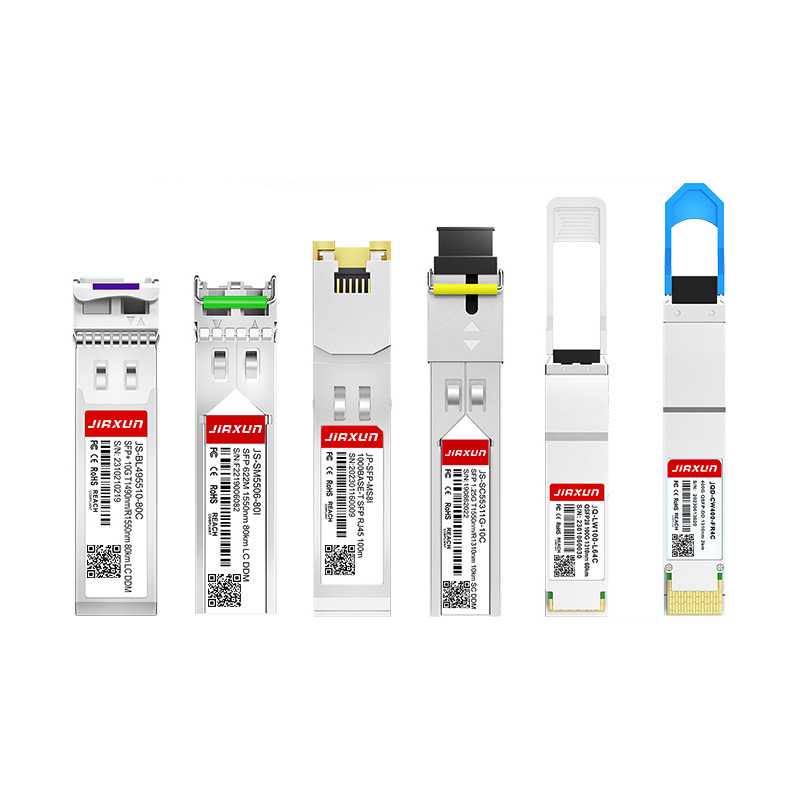
As global data traffic continues to grow rapidly, modern networks require faster and more efficient data transmission technologies. Optical transceivers play a critical role in fiber optic communication systems by converting electrical signals into optical signals for high-speed data transmission.
Complete Guide to SFP Modules and Optical Transceivers SFP, 10G SFP+, SFP28, QSFP28, QSFP-DD, 400G and 800G Modules Explained