RJ45 Modular Jack Connector: Complete Specifications & Design Guide for Engineers (2025)
Abstract
The RJ45 Modular Jack Connector is far more than a simple port on a device; it is the critical electro-mechanical interface that governs signal integrity, electromagnetic compatibility (EMC), and physical reliability in Ethernet networks. For design engineers, navigating the intricate specifications and design considerations of these components is paramount to the success of any product, from consumer gadgets to industrial IoT systems. This comprehensive guide delves into the 2025 landscape of RJ45 Modular Jack Connector technology, moving beyond basic pinouts to explore advanced material science, compliance standards, and integration strategies that define high-performance network design. We will dissect key parameters, compare integration methodologies, and provide actionable design rules to empower engineers to make informed decisions and avoid costly pitfalls.
1. Introduction: The Engineered Interface
In the realm of networked electronics, the RJ45 Modular Jack Connector serves as the first and last line of defense for data transmission. A poorly selected or integrated jack can lead to a cascade of failures: packet loss, reduced range, susceptibility to noise, and failure in compliance testing. The modern engineer must view this component not as a commodity but as a sophisticated subsystem encompassing magnetics, filtering, and ESD protection.
This guide is structured to provide a deep technical foundation. We will explore the anatomy, critical specifications, and the pivotal choice between discrete and integrated solutions. Furthermore, we will outline best practices for PCB layout and conclude with an examination of emerging trends and a profile of a leading innovator in the field, Jiaxun Intelligent Technology.
2. Anatomical Dissection of a Modern RJ45 Jack
Understanding the physical construction is key to understanding performance limitations and opportunities.
-
Housing:Typically made from high-temperature thermoplastics like PBT (Polybutylene Terephthalate) or LCP (Liquid Crystal Polymer). LCP offers superior flow properties for complex, miniaturized designs and better performance in lead-free reflow soldering processes.
-
Contacts: The gold-plated pins that mate with the plug. The plating thickness is critical. A minimum of 50 microinches (1.27 µm) is standard for good durability, while industrial-grade connectors may specify 100 microinches (2.54 µm) or more to withstand repeated mating cycles and resist corrosion.
-
Shielding: An internal metal cage (often nickel-silver or stainless steel) surrounds the contacts. Its purpose is to contain EMI radiating from the differential pairs and protect the signals from external RF interference. Shielded connectors are mandatory for FCC and CE compliance in many applications.
-
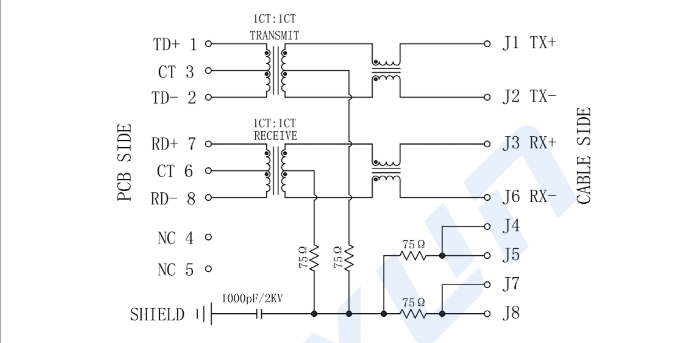
Magnetics Module (The Heart of the Interface): Integrated within the jack's body, this is arguably the most critical part. It contains:
-
Pulse Transformers: Provide galvanic isolation, typically 1500VAC or more, protecting PHY chips from voltage surges and ground loops.
-
Common Mode Chokes (CMC): Suppress common-mode noise, enhancing signal integrity and EMC performance.
-
Auto-Transformer (for PoE): In Power-over-Ethernet (PoE) applications, these components facilitate the DC power injection and extraction without interfering with the data signals.
-
-
LED Indicators: Integrated surface-mount LEDs (usually bi-color) provide link and activity status. Their placement requires careful optical design to channel light to the bezel effectively.
-
Latch Mechanism: The robust plastic latch must withstand thousands of insertion and removal cycles without failure. Strain relief features are often integrated to prevent cable pull-out from damaging the PCB mounts.

3. Critical Specifications Decoded for Design Engineers
Selecting the right RJ45 Modular Jack Connector requires a meticulous analysis of its datasheet.
| Specification | Definition & Impact | Design Consideration |
|---|---|---|
| Number of Positions | Almost universally 8P8C (8 Position, 8 Contact) for Ethernet. | Ensure compatibility with standard RJ45 plugs. |
| Mounting Type | Through-Hole (THT) or Surface-Mount (SMT). | SMT is dominant for automated assembly. THT may be preferred for extreme mechanical strength. |
| Port Orientation | Vertical, Right-Angle (Horizontal), or Panel-Mount. | Right-angle saves vertical board space. Vertical is often used with panel-mounted bezels. |
| Data Rate / Category | Cat5e (1 Gbps), Cat6 (1-10 Gbps), Cat6a (10 Gbps). | Match the jack's performance to the PHY chip and the application's bandwidth needs. Overspecifying (e.g., Cat6a for a 100Mbps link) can incur unnecessary cost. |
| Isolation Voltage | The voltage the internal transformer can withstand (e.g., 1500Vrms, 2000Vrms). | A higher rating provides better protection against surges and is often required in industrial and medical equipment. |
| Insertion Loss & Return Loss | Measured in dB; defines how much signal strength is lost and how much is reflected due to impedance mismatches. | Critical for achieving compliance with IEEE 802.3 standards. Lower insertion loss and higher return loss are better. |
| Common-Mode Rejection Ratio (CMRR) | The ability of the internal choke to reject common-mode noise. | A higher CMRR (e.g., >40dB @ 100MHz) dramatically improves noise immunity in electrically noisy environments. |
| ESD Protection | Integrated diodes or other circuits to shunt electrostatic discharge. | IEC 61000-4-2 Level 4 (15kV air, 8kV contact) is a common industrial requirement. Protects the sensitive PHY chip. |
| Operating Temperature | The ambient temperature range the connector is rated for. | Commercial: 0°C to +70°C. Industrial: -40°C to +85°C or higher. Material selection (e.g., LCP over PBT) is key for high-temp reflow and extended range. |
| PoE Compatibility | Support for IEEE 802.3af/at/bt (PoE, PoE+, PoE++). | The internal magnetics must be designed to handle the DC current without magnetic saturation, which would distort data signals. |
4. The Integration Dilemma: Discrete vs. Integrated Magnetics
This is a fundamental architectural decision every network designer must make.
-
Discrete Design (PHY Chip + External Magnetics Module):
-
Pros: Offers ultimate design flexibility. Engineers can select magnetics tuned for a very specific performance characteristic. Potentially lower BOM cost at very high volumes.
-
Cons: Significant additional PCB real estate required. Layout is extremely sensitive; poor routing between the PHY and magnetics can ruin signal integrity. Introduces more points of potential failure and requires more components to manage. This approach is increasingly rare in new designs.
-
-
Integrated Magnetic Jack (The Modern Standard):
-
Pros: The RJ45 Modular Jack Connector has the magnetics, termination resistors, and ESD protection built-in. This simplifies PCB layout dramatically, reduces board space by up to 50%, improves reliability by eliminating numerous discrete components, and speeds up time-to-market. Performance is guaranteed by the jack manufacturer.
-
Cons: Slightly higher per-unit cost. Less flexibility to tweak magnetic performance.
-
Verdict: For over 95% of designs, the integrated magnetic jack is the superior choice due to its reliability, performance consistency, and overall design efficiency.
-

5. PCB Layout Best Practices: Where the Rubber Meets the Road
Even the best RJ45 Modular Jack Connector will fail if poorly integrated into the PCB.
-
Placement and Routing to the PHY: This is the most critical signal path.
-
Length Matching: The differential pairs (TX+/TX-, RX+/RX-) must be length-matched to within 5-10 mils (0.13-0.25mm) to prevent skew and signal degradation.
-
Impedance Control: The traces must be routed as a 100-ohm differential pair. This requires careful calculation of trace width, spacing, and stack-up with your PCB fabricator.
-
Minimize Vias: Avoid vias on these high-speed lines if possible. Each via introduces an impedance discontinuity and stubs that can reflect energy.
-
Maintain Separation: Keep the differential pairs away from noisy sources like switching power supplies, clock lines, or other high-speed digital signals.
-
-
Grounding and Shielding:
-
The "Chassis GND" Tab: The metal shield of the jack must be connected to the chassis ground (if available) through a low-impedance connection, often via multiple vias or a dedicated grounding pad. This creates a Faraday cage to contain EMI.
-
Moating: It is common practice to have a physical gap (a "moat") in the PCB between the chassis ground connection point and the digital signal ground plane. These two grounds are typically connected at a single point, often through a high-voltage capacitor (e.g., 1000pF, 2kV) or a ferrite bead, to provide a path for high-frequency noise while breaking detrimental DC ground loops.
-
-
Power Decoupling: If the jack includes LEDs or active components, ensure they have local decoupling capacitors (100nF) placed as close as possible to their power pins.
6. The Future: Trends Shaping RJ45 Jack Design
-
Higher Speeds (Multi-Gigabit & 10GBase-T): As Cat6a and Cat7 cables become more common in offices and data centers, jacks must support higher frequencies with even tighter tolerances on insertion loss and return loss.
-
Miniaturization: The relentless drive for smaller devices demands smaller RJ45 Modular Jack Connector footprints and lower heights, pushing the limits of molding and magnetic design.
-
Enhanced PoE (IEEE 802.3bt - PoE++): Delivering up to 90W of power requires robust magnetics designed to handle higher currents without performance loss and improved thermal management within the jack housing.
-
Robustness for IoT and Industry 4.0: Demand is growing for connectors rated for extended temperature, higher vibration, and corrosive environments, featuring more robust latching mechanisms and specialized plating.

7. Partnering with a Specialist: The Jiaxun Intelligent Technology Advantage
In a field as specialized as magnetic interface design, partnering with an experienced manufacturer is not just a procurement decision—it's a strategic engineering advantage. Jiaxun Intelligent Technology (www.jiaxunzg.com) stands out as a leader in this precise domain.
With over 22 years of focused expertise, Jiaxun has dedicated itself to the research, development, and manufacturing of high-performance communication magnetic components. This deep domain knowledge translates directly into more reliable and efficient end-products for their clients.
Jiaxun's product portfolio is a testament to their engineering capability:
-
RJ45 Integrated Connectors with Magnetics: Their core product line spans from standard 10/100/1000BASE-T solutions all the way to high-performance 10G Ethernet jacks, all featuring integrated transformers and chokes. This simplifies design and ensures signal integrity out of the box.
-
Comprehensive PoE Support: Their jacks are fully compatible with IEEE 802.3af/at/bt standards, enabling the design of devices that can deliver or receive power over a single Ethernet cable.
-
Application-Specific Expertise: Jiaxun's components are engineered into a vast array of applications, including:
-
Network Infrastructure: Switches, routers, GPON/OLT equipment.
-
Industrial Automation: PLCs, industrial PCs, servo drivers.
-
Security & Surveillance: NVRs, DVRs, IP cameras.
-
Emerging Technologies: UAVs, Automotive systems, Data Center equipment.
-
For the design engineer, specifying a Jiaxun RJ45 Modular Jack Connector means leveraging two decades of accumulated design wisdom. It mitigates risk, accelerates development cycles, and provides assurance that this critical interface will perform to specification in the final product. Their team offers invaluable technical support, helping to navigate complex compliance requirements and optimize the integration of their components into new designs.
>> Explore their extensive catalog and access detailed datasheets directly at www.jiaxunzg.com to find the optimal connector solution for your next project.
8. Conclusion
Selecting and integrating an RJ45 Modular Jack Connector is a nuanced process that sits at the intersection of electrical engineering, mechanical design, and compliance testing. It requires a thorough understanding of specifications far beyond the basic pinout. By prioritizing critical parameters like isolation voltage, CMRR, and data rate, adhering to meticulous PCB layout practices, and leveraging the integrated solutions offered by specialized manufacturers like Jiaxun Intelligent Technology, engineers can ensure robust, reliable, and compliant network connectivity that forms the robust backbone of any modern electronic device.
MagJack RJ45 vs Standard RJ45: Key Differences & When to Use (Design Guide)
Top RJ45 Connector Factory for Custom OEM/ODM: Waterproof, Cat6/Cat7 Options