Hardware Engineer's Guide: Why Are 90W PoE++ RJ45 Ports Overheating? Contact Resistance, 1.0A Current Rating, and Thermal Control
In the era of 100M and legacy Gigabit Ethernet, the RJ45 modular jack was widely regarded by hardware designers as a routine signal interface. As long as the mechanical footprint aligned with the enclosure cutout, latch retention was solid, and the integrated LEDs toggled properly, component qualification was typically signed off without second thoughts.
However, the rapid rollout of high-density Wi-Fi 7 enterprise access points, PTZ 4K outdoor surveillance cameras with infrared illumination, 5G small cells, and smart building LED lighting grids has fundamentally transformed Ethernet power delivery. System power requirements have escalated from legacy IEEE 802.3af (15.4W) and IEEE 802.3at (30W) to IEEE 802.3bt (Type 3 and Type 4, commonly designated as PoE++), capable of delivering 60W up to 90W+ per port.
When 90W of continuous DC power is injected across standard 8-pin modular connectors, the RJ45 port ceases to be merely a low-voltage differential signal conduit. It becomes a critical power distribution node carrying up to 1.0A of continuous DC current per contact pair.
During hardware validation and field deployments, engineering teams frequently encounter three catastrophic failure modes:
- Unmating Under Load Contact Erosion: When a network cable is abruptly disconnected while delivering full 90W power, a localized electrical arc forms between mating surfaces. If contact gold plating is inadequate, arcing vaporizes the noble layer and exposes the copper-alloy substrate to rapid oxidation. Contact resistance spikes after only a few mating cycles, resulting in port failure or intermittent open circuits.
- Thermal Runaway in Sealed Enclosures: In compact 1U rackmount enclosures or sealed IP67 industrial gateways, dense multi-port configurations running continuous high-current PoE++ create severe thermal accumulation. Excessive terminal heating can deform plastic housings and induce solder-joint fatigue cracks on the PCB.
- Data Packet Dropping Under DC Power Injection: When discrete or poorly matched magnetic components are subjected to unbalanced DC bias currents through center taps, transformer cores easily saturate. Open Circuit Inductance (OCL) drops sharply, causing high-frequency signal degradation, eye-pattern closure, and cyclic packet loss.
This guide explores the underlying physical mechanisms of contact heating, evaluates critical qualification metrics, and presents field-proven engineering implementations from JIAXUN , a vertically integrated physical-layer connectivity manufacturer.
1. Physics First: Contact Resistance and Joule Heating Mechanisms
Mitigating PoE++ thermal failure requires analyzing electrical contact behavior at the micro-scale.
1.1 The Quadratic Joule Effect: Q = I²Rt
Under IEEE 802.3bt Type 4 specifications, Power Sourcing Equipment (PSE) supplies 52V to 57V DC. Delivering 90W to Powered Devices (PD) over 4-pair Category 6A cabling pushes loop current to approximately 0.96A, peaking at 1.0A per contact pair.
According to Joule's first law: Q=I2RtQ=I2Rt
Thermal dissipation increases quadratically with current. Compared to conventional Gigabit Ethernet signal current (~0.1A), a 1.0A continuous load represents a 10-fold increase in current, scaling theoretical Ohmic heating by two orders of magnitude (100×). Under these conditions, even a nominal 5 mΩ to 10 mΩ elevation in contact resistance translates into substantial localized thermal buildup.
1.2 Micro-Scale Aperity and Thermal-Oxidation Feedback
Apparent contact area between an RJ45 terminal blade and a plug wire is an engineering idealization. Real electrical contact occurs exclusively across microscopic surface peaks termed asperities. Under high current densities, these microscopic conductive bridges experience severe local temperature spikes.
Elevated local temperatures accelerate substrate metal migration and surface oxidation, generating non-conductive oxide layers. This oxidation shrinks effective conductive cross-sections, driving contact resistance higher and triggering further heating. Without sufficient initial contact pressure and durable surface metallurgy, this degradation loop leads directly to field instability.
2. Four Critical Engineering Selection Metrics
To ensure reliable 24/7 operation across industrial and enterprise network gear, hardware qualification must enforce four rigorous benchmarks rather than accepting generic datasheet claims of "PoE++ Ready":
2.1 Single-Contact Continuous Current Rating: Explicitly Rated for 1.0A
Standard commercial RJ45 connectors are commonly specified for only 0.5A signal current, with low-end PoE designs limited to 0.6A or 0.72A. Subjecting these units to 90W continuous operation leaves zero safety margin.
- JIAXUN Engineering Baseline: Across its high-power integrated connector family—such as the JIAXUN JG00 Series Gigabit MagJack and JIAXUN JM00 Series 10GBASE-T integrated modular jacks—individual contact pins are explicitly qualified for 1.0A continuous DC current, providing the thermal and cross-sectional headroom required for full IEEE 802.3bt Type 4 compliance.
2.2 Initial Contact Resistance: Factory Controlled to ≤ 20 mΩ
While commodity connectors permit loose tolerances of 30 mΩ to 50 mΩ, high-current power delivery demands minimal baseline resistance.
- JIAXUN Implementation: Through precision stamping dies and optimized terminal spring angles, JIAXUN connectors maintain consistent normal force throughout their mating life, keeping initial contact resistance strictly ≤ 20 mΩ to suppress resistive heating at the source.
2.3 Full-Load Temperature Rise: Typical ≤ 28 K (Limit ≤ 30 K)
Temperature rise (ΔTΔT) under maximum continuous load is the ultimate verification of thermal dissipation performance. Both IEC 60512 and enterprise switch qualification standards mandate that interface temperature rise must not exceed 30 K above ambient.
- JIAXUN Measured Performance: Tested under standard 25°C laboratory conditions with 1.0A continuous DC current across all four pairs, JIAXUN MagJack units demonstrate a typical temperature rise of ≤ 28 K, fully compliant with the ≤ 30 K specification limit. In sealed fanless industrial enclosures operating at 55°C ambient, internal junction temperatures remain safely within the -40°C to +85°C industrial temperature envelope.
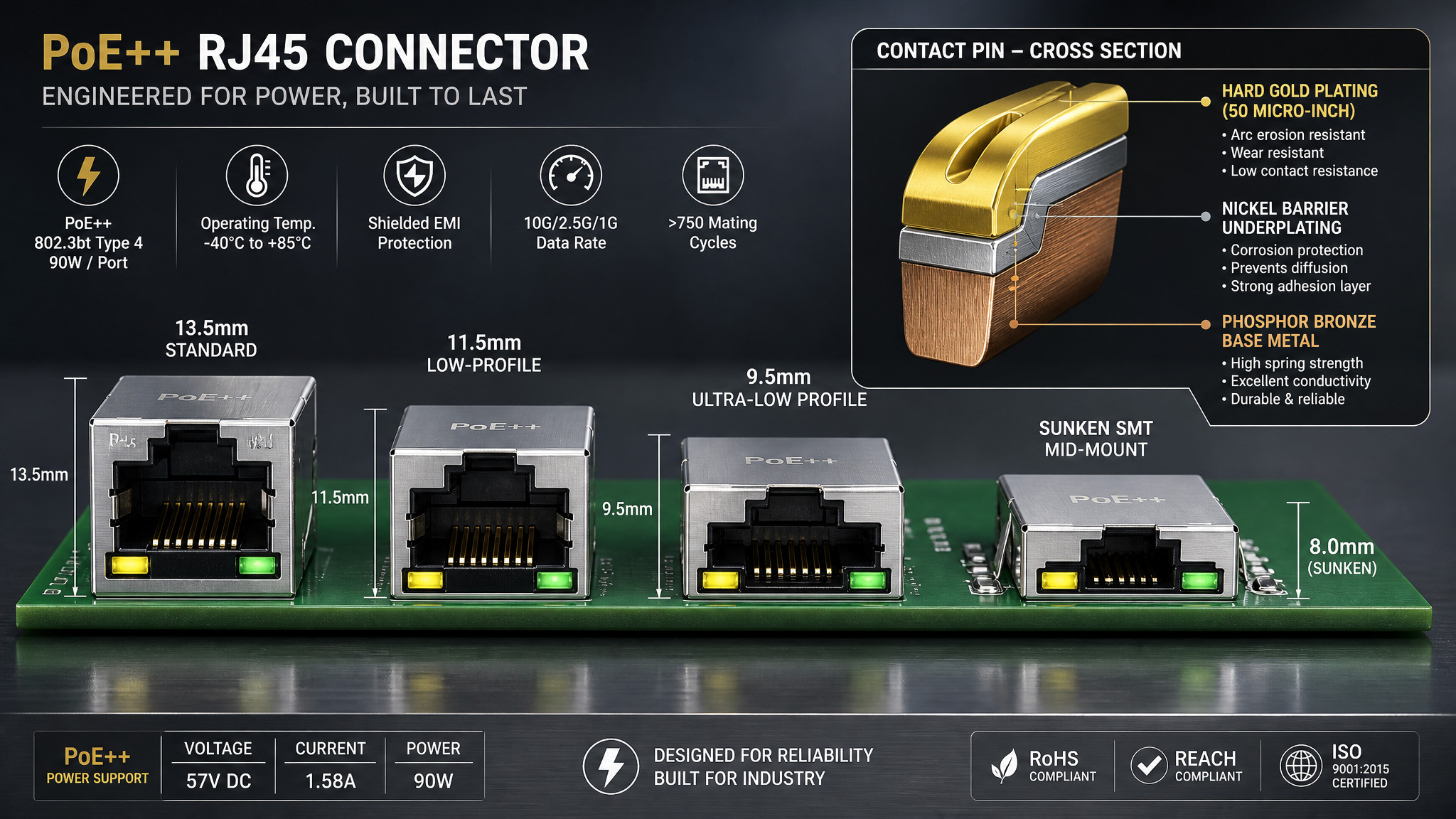
2.4 Electrochemical Surface Protection: 30 µin to 50 µin Hard Gold Over Nickel Underplate
When unmating under load, inductive kick generates micro-arcs with transient temperatures exceeding 1000°C. Thin flash-gold coatings (< 3 µin) vaporize almost instantly, exposing underlying nickel or phosphor bronze.
- JIAXUN Plating Standards: JIAXUN utilizes a dense electrolytic nickel diffusion barrier combined with selective hard gold electroplating. For harsh 90W industrial environments, JIAXUN standardizes on 30 µin (0.76 µm) or 50 µin (1.27 µm) hard gold options, retaining contact integrity and low resistance even after repeated hot-unmating cycles.
3. Mechanical Form Factors and Profile Constraints
Board real estate and front-panel enclosure heights frequently dictate connector form factors. JIAXUN provides an extensive mechanical matrix to accommodate diverse enclosure architectures:
JIAXUN Modular Jack Form Factors |
|
13.5 mm Standard Height |
Universal 1U Rackmount / Enterprise Switches |
11.5 mm Low Profile |
High-Density Blade Servers / Multi-Board Stacks |
9.5 mm Ultra-Low Profile |
Slim Industrial Panel PCs / Handheld Field Gear |
Jx59 SMT Mid-Mount Series |
PCB Cutout Sunk Type for Slim Industrial Routers |
Jx91-Jx95 Vertical Series |
Top-Entry Vertical Orientation (6.0-23.15 mm) |
Jx21x-Jx28x 2xN Stacked |
2x1 to 2x8 Multi-Port Dense Front Panels |
- Standard Profile (13.5 mm): The industry benchmark for 1U enterprise switches and industrial edge controllers, offering generous electrical clearance and isolation.
- Low-Profile Options (11.5 mm / 9.5 mm): Compresses vertical clearance for slim industrial computers, embedded DIN-rail gateways, and mezzanine boards.
- SMT Mid-Mount Sunk-Type (JIAXUN JT59 Series): Designed with PCB cutouts where the connector body rests flush with the board plane, sharing overall height between top and bottom sides. The JIAXUN JT59 Series (2.5G SMT mid-mount) is the primary choice for ultra-slim Wi-Fi 7 wall-plate access points and compact edge gateways.
- Vertical and High-Density Multi-Port: For vertical top-entry cabling, the JIAXUN JG91 through JG95 Series offer mating heights from 6.0 mm up to 23.15 mm with anti-twist stepped alignment posts. For high-density switch front panels, the JIAXUN J21x to J28x Stacked Series (available in 2x1, 2x2, 2x4, 2x6, and 2x8 multi-port layouts) delivers doubled port counts across four standardized body depths (28.5 mm, 34 mm, 38 mm, and 41 mm).
4. System-Level Synergy: Magnetics and Connector Co-Design
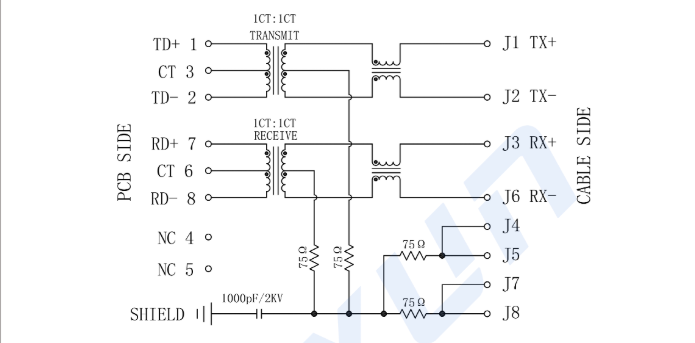
A common pitfall in discrete Ethernet design is coupling a standard RJ45 jack with an undersized discrete transformer. Under IEEE 802.3bt Type 4 operation, continuous DC current flows through the transformer center taps.
If magnetic wire gauges are insufficient or core materials exhibit poor DC bias tolerance, magnetic saturation occurs rapidly. When this happens, Open Circuit Inductance (OCL) collapses from the nominal ≥350 µH down to tens of microhenries. High-frequency return loss degrades immediately, leading to high bit error rates (BER), cyclic link drops, and severe packet loss that vanishes as soon as PoE power is disconnected.
As an integrated manufacturer of both network transformers and precision connectors, JIAXUN resolves this issue through coordinated co-design:
- Heavier Center-Tap Magnet Wire: Expanded winding cross-sections withstand 1.0A continuous DC current without excessive self-heating.
- High-Saturation Ferrite Cores: JIAXUN 10G transformers maintain OCL ≥ 75 µH under 40mA DC bias, while Gigabit variants maintain OCL ≥ 350 µH under 20mA DC bias, completely eliminating core saturation during maximum power delivery.
- Integrated Electro-Thermal Co-Simulation: Finite element thermal simulations model mutual heating between internal transformer windings and RJ45 terminal contact asperities (proven by typical ΔT≤28 KΔT≤28 K benchmarks), guaranteeing robust margins across the full operating range.
5. Hardware Engineer's Selection Checklist for 90W PoE++
Before finalizing schematic and layout sign-off for high-power PoE++ network ports, verify against this 6-point checklist:
- Current Specification: Is the single-contact continuous current explicitly rated for 1.0A DC (rather than 0.5A/0.6A standard signal ratings)?
- Contact Resistance Threshold: Is the factory initial contact resistance guaranteed at ≤ 20 mΩ?
- Full-Load Temperature Rise: Is continuous full-load temperature rise documented at ≤ 28 K typical (strict ≤ 30 K maximum) under 1.0A current?
- Electrochemical Wear Layer: Does the mating surface feature a nickel barrier with 30 µin or 50 µin hard gold electroplating for arc erosion resistance?
- Mechanical Envelope Optimization: Is enclosure height optimized using 13.5 mm standard, 11.5 mm/9.5 mm low-profile, orJIAXUN JT59 Series SMT mid-mount configurations?
- Magnetic DC Bias Immunity: Do integrated or discrete magnetics retain required OCL under rated DC bias current to prevent data corruption during simultaneous power delivery?
6. End-to-End Physical-Layer Solutions from JIAXUN
Beyond high-power PoE++ integrated connectors, JIAXUN manufactures an exhaustive physical-layer portfolio tailored for enterprise networking, industrial automation, and optical transport:
- Modular RJ45 Connectors: Complete series encompassing 100M (JX), 1G (JG), 2.5G (JT), 5G (JQ), and 10G (JM) speeds across single-port, vertical, SMT mid-mount, and 2xN stacked geometries.
- LAN Magnetics: Discrete and integrated transformers covering 100M to 10GBASE-T, featuring standard 1500 Vrms and reinforced 3000 Vrms industrial galvanic isolation.
- Optical Transceiver Cages: Precision SFP, SFP28, QSFP28, QSFP-DD, and OSFP shielding cages. Featuring continuous beryllium copper EMI spring fingers with gaps ≤ 0.15 mm, JIAXUN cages achieve shielding effectiveness of SE ≥ 70 dB @ 1 GHz, with over 440 drop-in replacements cataloged for seamless PIN-to-PIN second sourcing against Amphenol, Molex, and TE Connectivity (e.g., matching the widely deployed JIAXUN JX11BCS2000 SFP+ cage series).
- Optical Transceiver Modules: Complete transceivers spanning 100M to 800G. The flagship JIAXUN JS-SM311G-10C (1.25G 1310nm 10km SFP) provides verified multi-vendor firmware compatibility across more than 30 major switch and router platforms.
- Industrial Networking & PLC: Ruggedized managed/unmanaged industrial Ethernet switches alongside advanced Power Line Communication (PLC) carrier modules (such as the JIAXUN MN-L60C and JIAXUN MP-6500 series).
All JIAXUN components are backed by Commercial (0°C to 70°C), Industrial (-40°C to +85°C), Automotive Grade (AEC-Q200), and High-Reliability qualification tiers, providing global hardware developers with supply chain security, rapid customization, and zero-redesign second sourcing.
For detailed engineering datasheets, 3D STEP models, or qualification sample requests, visit the official JIAXUN website or contact the technical engineering team.
Gigabit POE+ RJ45 MagJack: Structure Analysis, Standard Classification and Engineering Selection Guide