Gigabit POE+ RJ45 MagJack: Structure Analysis, Standard Classification and Engineering Selection Guide
Abstract: As industrial Ethernet, IoT gateways, IP surveillance, and wireless network infrastructure continue to evolve, Gigabit RJ45 connectors with POE+ functionality have become indispensable core components of network hardware design. The Integrated RJ45 (also widely known as RJ45 MagJack) integrates isolation transformers, common-mode chokes, POE center tap power supply circuits, and EMC filtering structures into a single modular unit. Compared with discrete RJ45 solutions, it optimizes PCB layout, reduces BOM cost, suppresses electromagnetic interference, and ensures stable gigabit signal transmission and safe POE power delivery. This article systematically elaborates the internal circuit architecture, POE standard classification, internal winding differences, mainstream model specifications, and PCB design guidelines of POE+ RJ45 MagJack, providing professional reference for mass production hardware design and component selection.
Keywords: POE+ RJ45; Integrated RJ45; Gigabit RJ45; RJ45 MagJack
1. Introduction
Traditional discrete RJ45 sockets require additional matching magnetic components, which bring problems such as complicated wiring, inconsistent impedance, poor EMC performance, and high board occupancy. The RJ45 MagJack solves the above pain points through highly integrated design. All magnetic isolation and filtering components are pre-built inside the connector, achieving perfect integration of network signal isolation, common-mode noise suppression, and POE power superimposition.
In gigabit 1000BASE-T Ethernet, all four pairs of twisted wires undertake bidirectional data transmission without idle lines. Therefore, POE power supply cannot adopt the idle pair power supply mode of fast Ethernet. Instead, it relies on the center tap (CT) of the built-in isolation transformer to superimpose 48V DC power on high-frequency differential signals, realizing non-interfering co-line transmission of power and data. This working mechanism makes Integrated RJ45 the only cost-effective solution for current gigabit POE equipment such as POE switches, industrial gateways, IP cameras, and high-power wireless APs.
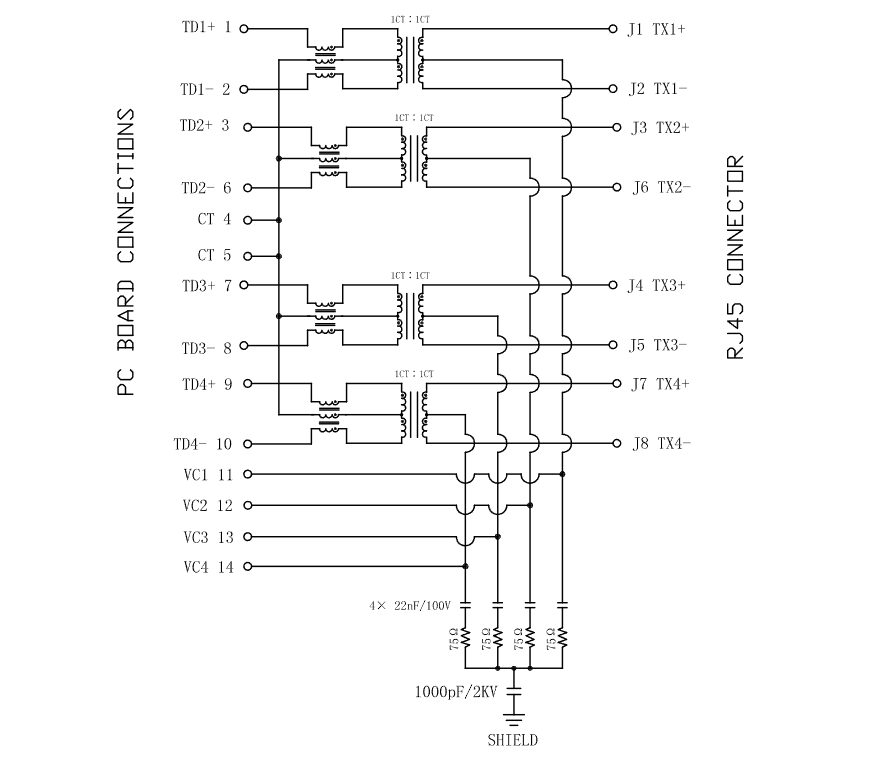
2. Internal Circuit Structure of POE+ Gigabit RJ45 MagJack
The complete internal circuit of the Gigabit RJ45 MagJack forms a closed-loop link from external network port to PHY chip, covering physical contact, signal isolation, power superposition, noise filtering, and grounding shielding. The hierarchical structure is standardized and unified, which directly determines signal integrity and POE load capacity.
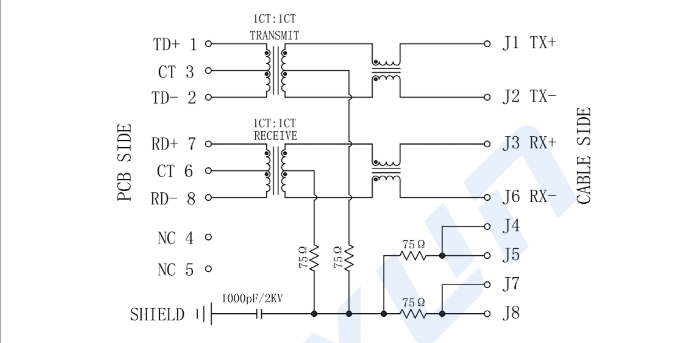
The standard internal link sequence is: RJ45 8-pin gold contact → precision internal PCB differential traces → four groups of gigabit pulse isolation transformers → POE dedicated center tap (CT) power circuit → integrated common-mode choke filter → optional LED indicator circuit → PHY-side differential signal pins → metal shield grounding and EMI suppression structure.
The core advantage of this integrated structure is ultra-short internal signal traces and consistent 100Ω differential impedance, which effectively reduces insertion loss and return loss, avoids signal attenuation and crosstalk, and fully meets the transmission requirements of gigabit high-speed signals. Meanwhile, the integrated shielding design greatly improves the EMC/EMI performance of the whole machine, which is more suitable for industrial and commercial harsh application scenarios than discrete schemes.
3. Two Core POE Power Supply Modes (Mode A / Mode B)
All mainstream POE+ RJ45 MagJack on the market adopt two standard power supply architectures, corresponding to IEEE 802.3af/at/bt international POE standards. The two modes differ in center tap extraction position and device compatibility, which is the key basis for engineering selection.
3.1 Mode A (Data Pair Power Supply, Industry Mainstream)
Mode A is the most widely used universal architecture, compatible with more than 95% of POE switches and terminal devices in the market, and the preferred solution for new projects.
-
Power supply path: Superimpose 48V DC power on 1/2 and 3/6 data differential pairs
-
Internal structure: Independent center taps (CT) are reserved for TX1/RX1 and TX2/RX2 transformer windings
-
Working principle: On the PSE power supply side, the CT of 1/2 winding is connected to +48V, and the CT of 3/6 winding is connected to GND; on the PD receiving side, the circuit separates high-frequency data signals and DC power to supply power to the rear-end equipment
-
Standard compatibility: Fully supports IEEE 802.3af (15.4W), 802.3at POE+ (30W), and 802.3bt 4PPOE (90W)
-
Applicable scenarios: Gigabit POE switches, high-definition IPC, industrial IoT gateways, enterprise wireless APs
3.2 Mode B (Spare Pair Power Supply, Narrow Compatibility)
Mode B is a backup power supply architecture, only compatible with a small number of old-fashioned POE devices, and not recommended for new mass-produced products.
-
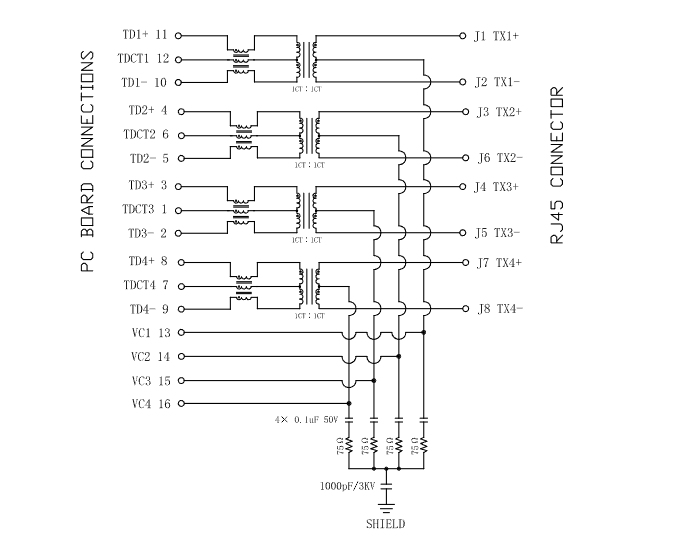
Power supply path: Realize power supply through 4/5 and 7/8 wire pair winding center taps
-
Structural requirements: Full four-group winding center tap design is mandatory; ordinary Mode A MagJack has no 4/5/7/8 tap structure and cannot support Mode B power supply
-
Application limitations: Poor universal compatibility, only used for legacy equipment docking
4. Winding Design Differences for Different POE Power Grades
Different POE power levels correspond to different internal wire diameters, magnetic core specifications and heat dissipation designs of Integrated RJ45. High-power POE+ and 4PPOE models require thicker windings and parallel conduction structures to withstand large operating currents and avoid overheating and voltage drop.
|
POE Standard
|
Max Power
|
Max Current
|
Internal Winding Design
|
Typical Application
|
|---|---|---|---|---|
|
802.3af
|
15.4W
|
350mA
|
Standard thin winding, single pair power supply, conventional heat dissipation
|
Low-power IPC, entry-level wireless AP
|
|
802.3at (POE+)
|
30W
|
720mA
|
Thickened winding, dual-winding parallel conduction, optimized current carrying and heat dissipation
|
HD surveillance camera, industrial gateway, commercial wireless AP
|
|
802.3bt (4PPOE)
|
90W
|
1200mA
|
Four-winding full parallel structure, thickened high-permeability magnetic core, low voltage drop design
|
High-power industrial equipment, AI intelligent terminal, outdoor high-end AP
|
5. Mainstream Gigabit POE+ RJ45 MagJack Model Recommendations
Combined with commercial and industrial mass production verification, the following high-stability Gigabit RJ45 MagJack models are recommended, covering SMT horizontal patch and DIP vertical plug-in packaging, which can meet different PCB layout and scene requirements.
5.1 Trxcom Industrial Grade Series (Mass Production Mainstream)
-
TRJG16301BENL: Classic POE+ 30W Mode A model, SMT horizontal type, with LED indicator and shrapnel, full-shield design, stable signal and strong compatibility, suitable for AP, IPC and small industrial gateways.
-
TRJG16302ADNL: A/B dual-mode POE compatible, ultra-thin no-LED patch structure, suitable for compact embedded network equipment.
-
TRJG0926HENL: Industrial 90W 4PPOE high-power model, full four pairs of center taps, wide temperature resistance (-40℃~85℃), for high-power industrial terminals.
-
TRJ1153AHNL: 180° DIP plug-in POE+ RJ45, 4kV high isolation voltage, dual LED indication, specially designed for gigabit POE switch motherboards.
5.2 Jiaxun Cost-Effective Civil & Commercial Series
-
JXB81066NL: Compatible with mainstream HR911130A packaging standard, stable 30W POE+ output, thickened winding design, suitable for commercial network equipment mass production.
-
JX-G1208PNL: Wide-temperature industrial model, fully compatible with af/at/bt three-level POE, excellent anti-interference performance.
-
JX-G0805DNL: Economical af standard POE model, no-LED simplified design, cost-effective for home monitoring and small switches.
5.3 International High-End Benchmark Models
-
Pulse HR911130A: Industry classic POE+ RJ45 MagJack, stable performance, fully verified by global high-end equipment projects.
-
Halo HFJT1-1GHP-L51RL: Industrial high-isolation 4PPOE++ model, strong EMC suppression capability, suitable for harsh industrial environments.
6. Engineering Selection Rules & PCB Design Specifications
Standardized selection and layout are the key to avoid POE power failure and gigabit signal packet loss. Engineers can quickly screen qualified devices through model suffixes and structural parameters.
6.1 Fast Selection Criteria
-
POE function judgment: Models with P/HP/GHP suffix support POE/POE+; ordinary RJ45 without center tap is forbidden for POE power supply scenarios to avoid short circuit and burnout.
-
Power mode judgment: G/GE suffix corresponds to single Mode A; Dual marks A/B dual-mode compatibility; 4P/BT represents 90W four-pair full power supply.
-
Packaging & appearance: SMT horizontal for compact terminal equipment; DIP vertical for switches with high heat dissipation requirements; ENL with LED, DNL without LED.
-
Temperature grade: Commercial grade 0℃~70℃, industrial wide temperature grade -40℃~85℃, mandatory for outdoor and industrial scenarios.
6.2 Key PCB Design Guidelines
-
Control the differential impedance between PHY chip and Integrated RJ45 strictly at 100Ω, and the intra-pair equal-length error shall be less than 5mil to ensure gigabit signal integrity.
-
Widen and copper-lay the POE center tap (CT) traces to reduce large-current voltage drop and overheating risk.
-
The metal shield of RJ45 MagJack adopts single-point grounding, multi-point parallel grounding is prohibited to suppress common-mode interference and EMI radiation.
-
High-power 4PPOE models need large-area copper laying on grounding and power supply pins to enhance heat dissipation and long-term operation stability.
-
Industrial equipment prefers MagJack with ≥4kV isolation voltage to meet surge and ESD protection specifications.
7. Conclusion
POE+ RJ45Integrated RJ45 (namely RJ45 MagJack) has become the standard configuration of modern Gigabit RJ45 network equipment by virtue of high integration, excellent signal performance and reliable power supply capacity. Its core technical advantages lie in precise transformer center tap design, standardized winding current-carrying specification and integrated EMC filtering structure.
In actual engineering design, Mode A POE+ architecture is the optimal universal solution, which can cover most commercial and industrial gigabit Ethernet scenarios. Reasonable selection of power grade, packaging form and temperature grade, combined with standardized PCB impedance control and grounding design, can completely solve common problems such as network packet loss, equipment overheating, POE incompatibility and EMC exceeding standards, ensuring long-term stable operation of mass-produced network equipment.
RJ45 Connector Types: Complete Guide to Choose the Right One (2026)