Are China RJ45 MagJack Connectors Good? An Engineer's In-Depth Analysis
For years, "Made in China" has carried a dual reputation in the electronics industry: unparalleled cost efficiency coupled with lingering doubts about quality and reliability. When it comes to critical components like the RJ45 MagJack—the integrated magnetic connector that serves as the physical gateway for Ethernet communication—these doubts are amplified. Engineers and procurement managers face a constant tension between budget constraints and the imperative for unwavering performance. The fundamental question remains: Can a China RJ45 Connector MagJack truly meet the rigorous demands of modern industrial, commercial, and consumer applications?
As an electrical engineer with over 15 years of experience in board-level design and component validation, I've tested MagJacks from virtually every major manufacturer and numerous suppliers from China's vast ecosystem. The answer is not a simple yes or no. The quality landscape is incredibly diverse. However, to dismiss the entire Chinese manufacturing base is to ignore a significant shift towards excellence driven by decades of accumulated experience and investment in advanced manufacturing and process control. The right supplier doesn't just offer a component; they offer a reliable, high-performance China RJ45 Connector MagJack that rivals and sometimes surpasses established international brands.
This analysis will move beyond stereotypes and provide a technical framework for evaluating quality, performance, and reliability.

Beyond the Stereotype: The New Reality of Chinese Manufacturing
The perception of Chinese components as universally low-quality is outdated. Many factories have evolved from simple contract manufacturers to Original Design Manufacturers (ODMs) and innovators. This is particularly true in the networking component space, where companies have spent decades honing their craft in producing transformers, chokes, and connectors. They have invested heavily in:
-
Automated Production Lines: Reducing human error in the winding of miniature transformers and the assembly of tiny components.
-
Advanced Testing Equipment: Implementing automated optical inspection (AOI), network analyzers for S-parameter testing (Insertion Loss, Return Loss), and rigorous Hi-Pot testers.
-
Quality Management Systems: Adopting ISO 9001 standards and building quality control into every stage of production, from raw material sourcing to final packaging.
-
R&D Investment: Developing new formulations for plastic housings, improving ferrite core materials for better high-frequency performance, and designing more effective EMI shielding.
The key is understanding that "China" is not a monolith. The market is stratified, ranging from low-cost, low-quality copycats to world-class manufacturers whose products are used invisibly in global brands. The engineer's task is to identify and qualify the latter.

A Technical Framework for Evaluation: How to Judge a MagJack
When we evaluate a MagJack, whether from a well-known multinational or a Chinese supplier, we apply the same rigorous technical criteria. Here’s what to look for:
1. Electrical Performance: The Heart of the Matter
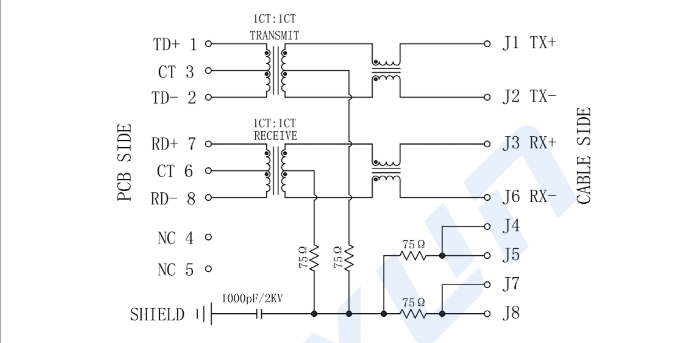
The primary function of the magnetics inside the RJ45 MagJack is to ensure signal integrity. This is quantified through S-parameter measurements.
-
Insertion Loss (S21): This measures the signal power lost as it travels through the connector. Excessive loss attenuates the signal, reducing cable reach and increasing bit error rates (BER). A high-quality China RJ45 Connector MagJack will have insertion loss well within the limits specified by IEEE Ethernet standards for its category (e.g., 1000BASE-T).
-
Return Loss (S11): This measures the amount of signal reflected back towards the source due to impedance mismatches. High return loss causes signal distortions and jitter. Good manufacturers provide detailed S-parameter plots in their datasheets.
-
Common-Mode Rejection Ratio (CMRR): The integrated common-mode choke suppresses noise that is common to both differential pairs. High CMRR is critical for maintaining signal integrity in electrically noisy environments and for passing EMI/EMC tests.
Engineering Insight: I have tested MagJacks from top-tier Chinese manufacturers like Jiaxun (佳迅) that demonstrate S-parameter performance virtually indistinguishable from those of TE Connectivity or Bel Fuse. The curves are clean, smooth, and well within specification limits.
2. Materials and Construction: Built to Last
The physical construction dictates durability and long-term reliability.
-
Plastic Housing: High-temperature Liquid Crystal Polymer (LCP) is the material of choice for lead-free (RoHS) reflow soldering. It prevents warping or melting during the high-temperature SMT process. Cheap connectors may use lower-grade plastics that can deform.
-
Contacts: The pins should be made of phosphor bronze with a thick, high-quality plating of gold over nickel. The nickel provides a barrier against corrosion, and the gold (even a thin flash) ensures low contact resistance and reliable mating over thousands of cycles.
-
Shielding: A robust, two-piece metal shield that fully encloses the magnetics is non-negotiable for EMI suppression. It should be securely crimped or soldered to the housing. Poor shielding is a primary cause of EMI compliance failures.
-
Transformer Windings: Automated, precision winding is essential for consistency. The quality of the enameled copper wire and the ferrite core material directly impacts performance.
3. Environmental and Regulatory Compliance
-
Temperature Rating: A commercial-grade rating (0°C to 70°C) is insufficient for many applications. A true mark of quality is an industrial temperature rating (-40°C to +85°C), which indicates superior materials and construction.
-
Isolation Voltage: This is a critical safety feature. Look for a minimum isolation of 1500Vrms. This protects your PHY chip and system from voltage surges on the cable.
-
Certifications: Legitimate manufacturers will have their components certified to relevant standards like UL (UL60950-1, UL62368-1), CE, and RoHS. These are not just logos on a datasheet; they represent a commitment to safety and environmental standards that requires independent verification.

The Application Spectrum: Where Chinese MagJacks Excel
Not every application requires a premium-grade component. The suitability of a China RJ45 Connector MagJack depends entirely on the use case:
-
Consumer & Low-End Commercial (e.g., cheap IoT devices, basic consumer electronics): This is where cost is the absolute primary driver. Many Chinese suppliers excel here, providing functionally adequate components at the lowest possible price. Reliability might be a calculated risk.
-
Mid to High-End Commercial & Industrial (e.g., enterprise switches, industrial controls, surveillance systems): This is the sweet spot for the top tier of Chinese manufacturers. Companies like Jiaxun (佳迅) produce MagJacks with industrial temp ratings, excellent EMI performance, and high reliability that are perfectly suited for these demanding applications. They offer the best value: high performance at a significantly lower cost than Western brands.
-
Mission-Critical & Automotive (e.g., medical devices, aerospace, automotive systems): This domain still heavily favors established international brands with long, proven pedigrees and specific certifications (e.g., AEC-Q200 for automotive). However, even here, advanced Chinese manufacturers are beginning to make inroads by achieving these specialized certifications.
How to Vet and Qualify a Chinese Supplier
The burden is on the engineer to perform due diligence. Here is a practical qualifying process:
-
Start with a Specialist: Look for companies that specialize in magnetics, not general component distributors. Jiaxun Smart Tech, for example, focuses exclusively on network magnetic components, which signals deeper expertise.
-
Scrutinize the Datasheet: A detailed, professional datasheet is the first filter. It should contain full electrical specifications, mechanical drawings, S-parameter plots, and compliance statements. A poor or vague datasheet is an immediate red flag.
-
Request and Test Samples: This is the most critical step. Order evaluation samples and put them through their paces:
-
Electrical Testing: Use a network analyzer to validate Insertion Loss and Return Loss.
-
Hi-Pot Test: Verify the isolation voltage.
-
Solderability Test: Check if the pins solder properly without defects.
-
Visual Inspection: Use a microscope to examine the mold lines, pin plating, and overall finish.
-
-
Audit and Inquire: Ask about their QMS, testing procedures, and manufacturing process. A reputable supplier will be transparent and may even provide factory audit reports.
-
Check References: If possible, find out who else uses their components. A supplier with other reputable Western companies as clients is a very strong positive indicator.
Frequently Asked Questions (FAQs)
Q1: Aren't all Chinese MagJacks just cheap copies of Western designs?
A: This is a common misconception. While copying exists, many leading Chinese manufacturers invest significantly in their own R&D. They often develop their own proprietary designs for ferrite cores and winding techniques to optimize performance and cost. They are innovators in process engineering, finding ways to manufacture high-quality components more efficiently.
Q2: How can I ensure consistency across large production batches?
A: Consistency is a function of automation and process control. This is where top-tier Chinese suppliers shine. Inquire about their Automated Optical Inspection (AOI) systems, their statistical process control (SPC) methods, and their batch testing protocols. A professional supplier will test a significant sample from every production lot and can provide the test reports.
Q3: What is the biggest risk when sourcing from China, and how do I mitigate it?
A: The biggest risk is the lack of transparency and the potential for a supplier to change the Bill of Materials (BOM)—switching to a cheaper material or skipping a testing step—without notification after the initial samples are approved. This is called "bait-and-switch." Mitigation involves building a relationship with a reputable supplier, conducting periodic audits, and performing rigorous incoming quality control (IQC) checks on production batches.
Q4: Is the cost savings really worth the potential hassle?
A: For high-volume projects, the cost savings can be substantial, often 30-50% compared to major international brands. This can be the difference between a profitable product and a failed one. The "hassle" is mitigated by doing the upfront work of properly qualifying a supplier. Once a reliable partner like Jiaxun is qualified, the long-term relationship becomes seamless and highly valuable.
Q5: Can I get custom specifications from a Chinese manufacturer?
A: Absolutely. In fact, this is one of their greatest strengths. Chinese manufacturers are typically far more flexible and responsive to custom requests—such as specific lead lengths, custom shielding, unique pin layouts, or specialized performance tuning—than larger Western corporations, and they can do it with much lower Minimum Order Quantities (MOQs).
Partnering with a Proven Specialist: Jiaxun Smart Tech
When seeking a China RJ45 Connector MagJack that delivers both quality and value, partnering with an established specialist is paramount. Jiaxun Smart Tech (佳迅智能科技) exemplifies this class of manufacturer. With 22 years of focused experience, they are not a generic component factory but a dedicated designer and producer of communication network magnetic components.
Jiaxun's entire business is built around the engineering and manufacture of:
-
RJ45 Integrated Network Transformers (MagJacks): Their core product, combining the jack, transformer, and choke into a single, reliable module.
-
RJ45 Modular Interfaces: Offering various port configurations.
-
Ethernet Pulse Transformers: Providing discrete solutions for specialized designs.
Their product portfolio covers the entire spectrum of Ethernet speeds, from 10/100/1000M (Gigabit) up to 10G, ensuring compatibility with both legacy and cutting-edge equipment. Crucially, their components are engineered for reliability in demanding applications, including:
-
Industrial Switches & Routers: Where -40°C to +85°C operation is standard.
-
Network Security & Surveillance (安防设备): Demanding uninterrupted data flow.
-
Data Center Equipment: Requiring high density and signal integrity.
-
IoT Gateways & Drone (无人机) Communications: Where size, weight, and reliability are critical.
By choosing Jiaxun, you are not just buying a component; you are leveraging deep domain expertise. Their engineers understand the nuances of magnetic design, signal integrity, and EMI mitigation. They offer the technical support and design-in assistance necessary to ensure your product performs flawlessly, providing a compelling alternative that answers the question "Are China RJ45 MagJack Connectors Good?" with a resounding and qualified "Yes."
About the Author: This analysis was conducted by a seasoned electrical engineer and component validation specialist with over 15 years of experience in the networking and telecommunications hardware industry. The opinions and insights are based on firsthand laboratory testing and tear-down analysis of hundreds of components from global suppliers. The goal is to provide an unbiased, technical perspective to assist engineering and procurement professionals in making informed decisions.
Top 10 Magnetic RJ45 Connectors for Industrial and Networking Applications in 2024
Top 10 RJ45 MagJack Connectors for Industrial Ethernet Applications in 2024