MagJack RJ45 vs Standard RJ45: Key Differences & When to Use (Design Guide)
For hardware engineers laying out a new board, the choice of connectivity components is foundational. The humble Ethernet jack seems simple, but this is where a critical decision point emerges: do you use a standard RJ45 jack and external discrete magnetics, or an integrated MagJack RJ45 module? This choice, made early in the design cycle, ripples through your board's performance, cost, assembly time, and EMI certification fate.
This guide moves beyond basic definitions to provide a practical, engineering-focused comparison. We'll dissect the architectural differences, trade-offs, and precise application advice to ensure you make the optimal choice for your next design.

1. Architectural Deep Dive: What Are You Actually Using?
Standard RJ45 Connector: The Discrete Approach
A standard RJ45 jack is purely a mechanical and electrical interface. It provides:
-
Physical Port: The plastic housing and eight gold-plated pins that accept an Ethernet cable plug.
-
Signal Pass-Through: It routes the signals from the PCB traces directly to the cable pins.
What it DOESN'T have: Any form of magnetic components. This is the crucial point.
Therefore, using a standard RJ45 jack necessitates a set of external discrete components placed on the PCB between the jack and the Ethernet PHY (Physical Layer) chip:
-
Pulse Transformers: One for each pair (4 total for 10/100/1000BASE-T). These provide DC isolation, impedance matching, and common-mode noise rejection.
-
Common-Mode Chokes (CMC): Further suppress common-mode noise, crucially reducing electromagnetic interference (EMI).
-
Termination Resistors & Capacitors: Required for proper signal conditioning and biasing.
This "discrete magnetics" solution is a circuit you must design and lay out yourself.
The MagJack RJ45: The Integrated Approach
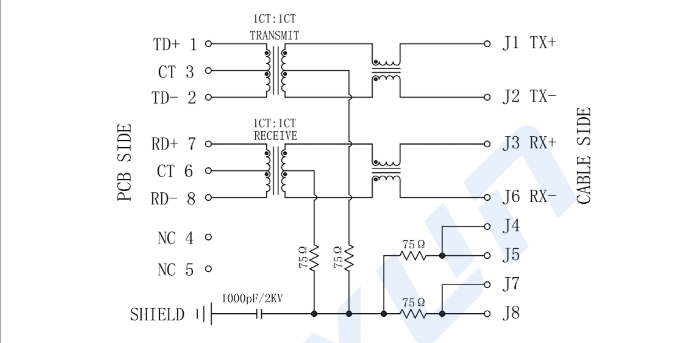
A MagJack RJ45 is a single, integrated component that combines:
-
The standard RJ45 mechanical jack.
-
All the necessary pulse transformers.
-
The common-mode chokes.
-
The termination resistors (often integrated into the substrate).
-
Sometimes, even Bob-Smith termination for enhanced EMI performance.
All these elements are pre-wired, pre-tested, and encapsulated within a single, shielded plastic package. You are essentially outsourcing the entire analog magnetic circuit to a specialist manufacturer.
2. Head-to-Head Comparison: A Designer's Decision Matrix
| Feature | Standard RJ45 + Discrete Magnetics | Integrated MagJack RJ45 |
|---|---|---|
| Board Space (PCB Real Estate) | High. Requires significant area for the jack + 8-12 discrete components. | Low. All components are vertically integrated. Can save 50-70% of board space. |
| Bill of Materials (BOM) Complexity | High. More line items to source, qualify, and manage. | Low. One component replaces many. Simplifies procurement and reduces SKU count. |
| Design & Layout Complexity | High. Engineer must design the magnetic circuit, ensure proper placement, and carefully route differential pairs to and from the discrete components. Very sensitive to layout. | Low. The complex internal routing is done for you. The designer simply routes the PHY's differential pairs directly to the MagJack's pins. |
| Performance & Signal Integrity | Potentially High (with expertise). An expert layout with high-quality discrete components can yield excellent performance. | Consistently Good & Predictable. Performance is guaranteed by the MagJack vendor. They have optimized the internal layout for best EMI and signal performance. |
| EMI/EMC Compliance | Variable. Highly dependent on the PCB layout skill of the engineer. Hard to get right the first time. | Superior & Consistent. The shielded, pre-tested package is designed to minimize radiated emissions. Greatly simplifies passing FCC/CE tests. |
| Time-to-Market | Longer. More components to place, more complex layout, higher risk of design spins due to failed EMI tests. | Faster. Simplifies layout, reduces component count, and increases first-pass success rate in compliance testing. |
| Unit Cost | Potentially Lower for very high-volume products where saving cents per unit is critical. Cost is for jack + magnetics. | Slightly Higher per unit. You are paying for integration, testing, and convenience. |
| Total Cost of Ownership | Higher when considering extended design time, risk of re-spins, inventory management, and assembly costs for more components. | Often Lower. The savings in engineering time, reduced PCB size, and assembly simplicity often outweigh the higher unit cost. |
| Flexibility & Customization | High. Engineers can select specific magnetics tuned for very particular needs (e.g., extreme CMRR). | Lower. You are limited to the standard or custom-offered configurations from MagJack suppliers. |
| Reliability & Fault Isolation | More Failure Points. A failure could be in the jack, any transformer, or any choke. | Single Point of Failure. However, the component is highly reliable and tested as a complete system. |

3. When to Use Which: Application-Based Guidance
Use a Standard RJ45 + Discrete Magnetics When:
-
Extreme Cost Sensitivity is Paramount: You are manufacturing millions of units of a product (e.g., a simple consumer IoT device), and every cent on the BOM is scrutinized. The volume discounts on discretes can win out.
-
You Have Unique Performance Requirements: Your design requires non-standard magnetic characteristics that aren't met by off-the-shelf MagJack RJ45 modules. This is a rare, high-performance edge case.
-
Board Height is NOT a Constraint: The discrete solution typically has a lower profile than an integrated MagJack.
-
You Possess Deep RF/EMC Expertise: Your team has the experience and simulation tools to design a robust discrete magnetic circuit and layout that will pass EMI/EMC tests on the first few tries.
Use an Integrated MagJack RJ45 When:
-
Time-to-Market is Critical: For most startups and companies launching new products, getting to market fast is a top priority. The MagJack RJ45 drastically reduces design risk and complexity.
-
PCB Space is Limited: This is the most common reason. For compact designs like network switches, routers, single-board computers, and IoT gateways, the space savings are invaluable.
-
You Want to Simplify EMI Certification: If you dread pre-compliance testing, the MagJack RJ45 is your best friend. It is the single most effective step you can take to minimize radiated emissions from the Ethernet interface.
-
You Lack In-Depth Magnetics Expertise: Not every team has an EMC guru. Using a MagJack RJ45 allows you to leverage the expertise of the magnetic component manufacturer.
-
For Most Industrial, Enterprise, and Automotive Applications: These fields demand reliability and robustness. The pre-tested, shielded nature of a MagJack RJ45 makes it the default choice for these demanding environments.
4. PCB Layout Considerations for MagJack RJ45
Choosing a MagJack RJ45 simplifies layout, but doesn't eliminate critical design rules:
-
Keep Differential Pairs Short and Matched: Route the TX± and RX± pairs from the PHY to the MagJack as tightly coupled differential pairs. Maintain impedance at 100Ω ±10%.
-
Provide a Solid Ground Plane: A continuous ground plane adjacent to the signal layers is essential for providing a return path and controlling impedance.
-
Follow Manufacturer's Guidelines: Every MagJack RJ45 datasheet has a recommended landing pattern and layout example. Follow it religiously. This is the result of the vendor's extensive testing.
-
Use Vias Judiciously: Minimize the use of vias in the differential paths. If you must use them, ensure they are symmetric for each pair.
-
Power Supply Decoupling: Place decoupling capacitors as close as possible to the MagJack's power pins (if it has integrated LEDs), following the datasheet values.

5. FAQs: Answering Common Engineering Questions
Q1: Can I simply replace a discrete magnetic design with a MagJack RJ45?
A: Not directly without a PCB re-spin. The footprints are completely different. A MagJack RJ45 requires a specific landing pattern that integrates the connections for all its internal functions. You must select the MagJack early in the design process.
Q2: Are all MagJack RJ45 modules compatible with all Ethernet PHY chips (e.g., Intel, Marvell, Broadcom)?
A: While many are designed for broad compatibility, it is not guaranteed. Subtle differences in impedance, return loss, and common-mode rejection can exist. Always consult the application notes for your specific PHY chip. Most reputable MagJack suppliers provide compatibility lists.
Q3: How do I select the right MagJack RJ45 for my application?
A: Key selection criteria include:
-
Data Rate: 10/100Mbps, 1000Mbps (1G), 2.5G, 5G, or 10GbE.
-
Number of Ports: Single-port, dual-port, or stacked configurations.
-
LED Configuration: Number of LEDs (1 or 2) and their placement (side or front view).
-
Shielding: Metal shield for enhanced EMI performance, often required for office/industrial equipment.
-
Height Profile: Low-profile options for space-constrained designs.
-
Pinout: Must be compatible with your PCB layout and PHY pinout.
Q4: What's the primary cause of failure in a MagJack RJ45?
A: Mechanical failure (broken plastic or pins from physical abuse) is the most common. Electrical failure is exceedingly rare in quality modules from reputable suppliers, as the internal components are protected from environmental factors and ESD events.
Q5: Why would a MagJack RJ45 have more pins than the 8 used for data?
A: The extra pins serve several purposes: connections for the integrated LEDs (anode and cathode), additional grounding pins for the metal shield to improve EMI performance, and sometimes test points or configuration pins. Always check the pinout diagram in the datasheet.
Partnering with a Specialized Manufacturer: JIAXUN (佳迅智能科技)
Navigating the nuances of magnetic integration requires a supplier that specializes in more than just connectors. It requires deep domain expertise in electromagnetic theory, material science, and high-frequency signal integrity. This is where a focused manufacturer like Jiaxun Intelligent Technology Co. (佳迅智能科技) provides significant value beyond that of a standard component distributor.
With over 22 years of dedicated experience, Jiaxun is not a general-purpose component supplier. The company is a professional design and manufacturing enterprise whose entire focus is on communication network interface magnetic elements. This specialization is their core strength.
Jiaxun's product portfolio is a testament to this focus, offering comprehensive solutions that include:
-
RJ45 Integrated Connectors (MagJack RJ45): Their core product line, covering data rates from 10M/100M up to 10GbE, available in single, dual, and multi-port configurations with various shielding and LED options to meet diverse application needs.
-
Modular RJ45 Interfaces: Providing robust and reliable connection solutions for a wide array of networking equipment.
-
Ethernet Network Pulse Transformers: For designers who prefer or require the discrete approach, they offer high-quality standalone magnetic components.
The applications for their products are critical to modern technology infrastructure, found in:
-
Network Switches and Routers: From enterprise core switches to small business and home office equipment.
-
Security and Surveillance Systems: Network video recorders (NVRs), IP cameras, and access control systems.
-
Data Center Equipment: Storage area network (SAN) devices, servers, and top-of-rack switches.
-
Industrial Control and IoT: PLCs, IoT gateways, and automation controllers where reliability is non-negotiable.
-
UAVs (Drones) and Automotive Systems: Advanced applications requiring robust communication links.
For a hardware engineer, selecting a MagJack RJ45 from a specialist like Jiaxun means you are not just buying a component. You are leveraging two decades of accumulated magnetic design knowledge, which is baked into every module. This partnership can drastically de-risk your design process, particularly for challenging EMI environments or when designing for high-reliability applications. Their ability to provide certified (RoHS, UL) and performance-verified products makes them a strategic partner in achieving a successful and timely product launch.
Disclaimer: This article is for informational purposes. Always consult the datasheets and application notes for your specific PHY chip and chosen MagJack RJ45 component and conduct thorough testing in your own design context.
Top 10 RJ45 MagJack Connectors for Industrial Ethernet Applications in 2024
RJ45 Modular Jack Connector: Complete Specifications & Design Guide for Engineers (2025)