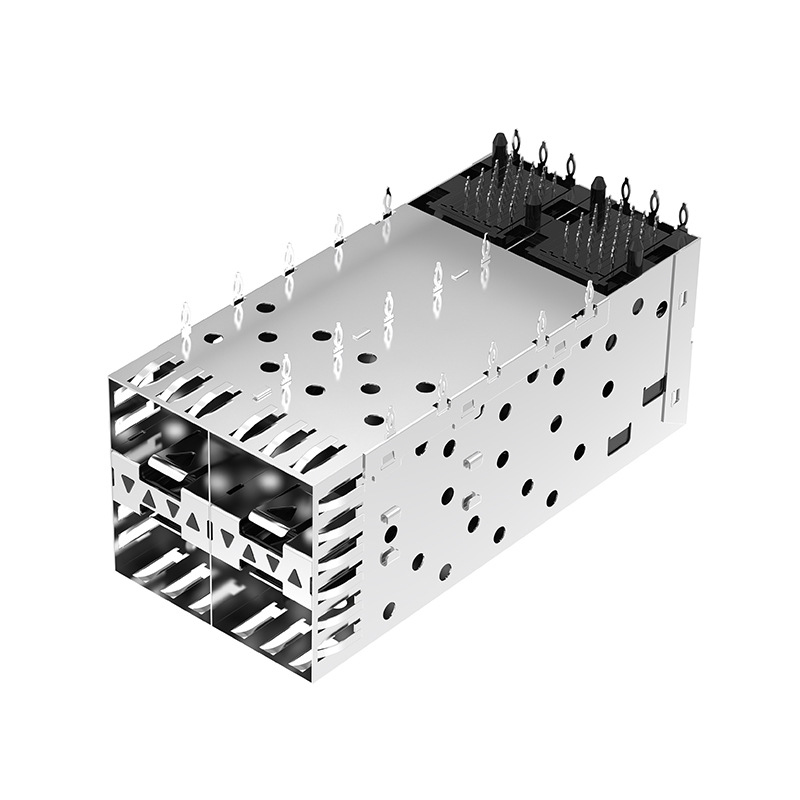
SFP Cage vs. SFP Module: What’s the Difference and How Do They Work Together?
If you're delving into the world of network hardware, you've undoubtedly encountered the terms "SFP module" and "SFP cage." To the uninitiated, they might seem interchangeable, but confusing them can lead to costly design errors, procurement mistakes, and frustrating hours of troubleshooting. Understanding the distinct roles each component plays is fundamental to building a reliable and high-performance network.
This comprehensive guide, drawn from years of hands-on field experience, will demystify these critical components. We'll break down what each part is, its unique function, and, most importantly, how they work in perfect harmony to connect our digital world.

Understanding the SFP Module: The "Brains" and "Translator"
Let's start with the more commonly discussed component: the SFP module.
What is it?
A Small Form-factor Pluggable (SFP) module, often called a "transceiver," is a compact, hot-swappable device that plugs into a network switch, router, network card, or similar equipment. Its primary job is to act as an interface between the device's internal electronics and the external network cabling.
Think of it as a sophisticated translator. The device itself communicates using electrical signals over copper traces on its motherboard. The external network might use pulses of light over fiber optic cables or electrical signals over copper twisted-pair cables. The SFP module's core function is to convert these signals.
-
Fiber SFP Modules: Convert internal electrical signals to external optical light signals (and vice-versa). They have ports for LC, SC, or other fiber connectors.
-
Copper SFP Modules (like 1000BASE-T): "Media convert" electrical signals from the device to the different electrical standards required for running over RJ45 Ethernet cables (like Cat6/Cat6a).
Key Characteristics of an SFP Module:
-
Pluggable: Designed to be easily inserted and removed without powering down the equipment.
-
Varied Types: Comes in many forms depending on data rate (e.g., SFP, SFP+, SFP28, QSFP28), wavelength (e.g., 850nm, 1310nm, 1550nm), and cable type (multimode/single-mode fiber, copper DAC).
-
Intelligent: Contains a small memory chip (EEPROM) that stores vital information like vendor, model, serial number, supported capabilities, and real-time diagnostic data (DOM/DDM). This allows the host device to identify and configure the module correctly.
In essence, the SFP module is the replaceable, smart, adaptive component that defines the physical connection type.
Understanding the SFP Cage: The "Docking Station" and "Guardian"
Now, let's meet its indispensable partner: the SFP cage.
What is it?
An SFP cage (or SFP receptacle) is a mechanical and electrical socket soldered directly onto the printed circuit board (PCB) of the host device—be it a switch, a router, or a network interface card (NIC). It is the permanent, fixed interface designed to receive and secure an SFP module.
If the SFP module is the translator, the SFP cage is the dedicated podium and security detail for that translator. It provides the physical and electrical framework that allows the module to function reliably.
The Multifaceted Role of an SFP Cage:
-
Physical Housing and Guidance: The primary role of the SFP cage is to provide a precisely sized port for the SFP module to slide into. Its mechanical design ensures perfect alignment for the electrical connector, preventing damage to the delicate pins on both the module and the PCB.
-
Electrical Interconnection: At the rear of the SFP cage is a sophisticated connector that mates with the golden fingers of the inserted SFP module. This creates the critical electrical pathway for high-speed data signals, power, and the two-wire serial bus (I2C) used for the module's EEPROM communication.
-
Electromagnetic Interference (EMI) Shielding: This is a crucial yet often overlooked function. A high-quality SFP cage is manufactured from metal and features numerous finger-stock contacts. When a module is fully inserted, these contacts form a 360-degree Faraday cage around the transceiver. This shielding is vital for:
-
Containing high-frequency signals within the assembly.
-
Preventing external EMI from disrupting sensitive internal electronics.
-
Ensuring regulatory compliance (like FCC/CE) for electromagnetic emissions.
-
-
Thermal Management (Heat Dissipation): SFP modules, especially higher-power variants like SFP+ and optics for long-reach transmissions, generate heat. The metal construction of the SFP cage acts as a heat sink, drawing thermal energy away from the module and dissipating it into the surrounding air, aided by the device's overall airflow. A poorly designed cage can lead to module overheating, premature failure, and data errors.
-
Latching and Ejection Mechanism: The SFP cage incorporates features that work with the module's built-in latch. This mechanism securely holds the module in place during operation and provides a means to release it (often with a pull tab or latch actuator) for safe removal.
In summary, the SFP cage is the permanent, passive, but critically important infrastructure that makes the plug-and-play magic of SFP modules possible.

The Synergy: How the SFP Cage and SFP Module Work Together
Their relationship is a perfect example of symbiotic engineering. One is useless without the other.
-
Insertion: A network engineer selects an appropriate SFP module (e.g., a 10G LR module for long-range fiber) and aligns it with an empty SFP cage on a switch.
-
Connection: As the module is slid into the SFP cage, the guide rails ensure it goes in straight. The cage's internal electrical connector mates perfectly with the edge connector on the module.
-
Securing and Shielding: The module is pushed until the latch clicks, securing it physically. Simultaneously, the cage's EMI shielding fingers make firm contact around the module's metal shell, creating a protective enclosure.
-
Communication and Operation: Upon power-up, the host device queries the module's E2PROM via the serial bus provided through the SFP cage. It identifies the module, configures its settings accordingly, and begins sending and receiving data through the high-speed signal paths now connected via the cage.
-
Maintenance: If an upgrade or replacement is needed, the engineer activates the latch, breaks the EMI seal, and slides the module out. A new one is inserted, and the system can recognize it almost instantly—thanks to the stable foundation provided by the SFP cage.
This seamless interaction allows for incredible flexibility. A single switch with 24 SFP cages can be configured with any combination of 1G/10G/25G fiber and copper transceivers, tailored precisely to the network's needs, without requiring any internal hardware changes.
Key Differences at a Glance
| Feature | SFP Module | SFP Cage |
|---|---|---|
| Function | Active Transceiver (Signal Conversion) | Passive Receptacle (Interface & Protection) |
| Mounting | Hot-swappable; user-replaceable | Soldered to the device's motherboard |
| Nature | Flexible, configurable component | Fixed, permanent infrastructure |
| Primary Role | Defining media type (fiber/copper) & reach | Providing physical/electrical interface & EMI shielding |
| Lifespan | Can be replaced if faulty or upgraded | Intended to last the lifetime of the host device |
Common Questions & Problems (And How to Solve Them)
Q1: Can I use any SFP module with any SFP cage?
A: Generally, yes, within the same form factor family. A standard SFP module fits a standard SFP cage. An SFP+ module fits an SFP+ cage and is often backwards compatible with SFP cages (typically operating at 1G speeds). However, you cannot fit an SFP+ module into a QSFP cage, or vice versa. Always check the device's datasheet for compatibility, as some manufacturers use coded cages that only work with their branded modules.
Q2: Why is my new SFP module not being recognized by the switch?
A: This common issue can have several causes:
-
Compatibility Coding: The switch's firmware may be looking for a specific vendor code. You may need a compatible module from a third-party manufacturer like Jiaxing Intelligent Tech that is pre-coded for your switch brand.
-
Dirty or Damaged Connectors: Contamination on the SFP cage's internal electrical contacts or the module's golden fingers can prevent communication. Inspect and clean with compressed air and isopropyl alcohol on a swab if needed.
-
Faulty SFP Cage: In rare cases, the SFP cage itself may be damaged from physical trauma (e.g., bent pins from improper insertion) or ESD (electrostatic discharge). This often requires professional motherboard repair.
Q3: My link is unstable and dropping packets. What could be wrong?
A: Instability is often thermal or related to signal integrity.
-
Overheating: Touch the module. If it's too hot to touch, it's overheating. This could be due to a faulty module, insufficient airflow in the device, or a SFP cage that is not effectively dissipating heat.
-
EMI Issues: If the EMI shielding fingers on the SFP cage are damaged or not making good contact, external interference can corrupt the high-speed signals, causing errors and drops.
-
Low-Quality Components: A poorly manufactured module or a substandard SFP cage with imprecise impedance control can lead to signal reflections and degradation.
Q4: The SFP module is extremely difficult to insert or remove. What should I do?
A: Never force it! Forcing can destroy both the module and the cage. Misalignment is the likely culprit. Ensure you are inserting the module perfectly straight into the SFP cage. Check for any visible obstructions or bent metal inside the cage. Using a module from a reputable manufacturer ensures it meets precise dimensional standards.
Q5: Are there different types of SFP cages?
A: Absolutely. While the basic function is the same, SFP cages differ in:
-
Data Rate: Cages are designed for specific frequency ranges (e.g., for 1G/10G/25G/28G) with controlled impedance to maintain signal integrity.
-
Height: Low-profile (LP) cages are used in blade servers or cards with height restrictions.
-
Shielding: The quality and design of the EMI gasket can vary significantly between manufacturers.
-
Latching Mechanism: Some designs are optimized for specific actuator styles.

Choosing Quality Components: A Recommendation for Reliable Performance
The reliability of your network links depends entirely on the quality of both the SFP modules and the SFP cages they plug into. Using poorly made, off-brand components is a false economy that leads to network downtime, difficult-to-diagnose problems, and potential damage to expensive primary equipment.
For over a decade, Jiaxing Intelligent Technology Co., Ltd. has been a trusted global manufacturer and supplier of high-performance network connectivity solutions. Our deep expertise ensures that every product is engineered to the highest standards of performance and reliability.
While we are renowned for our wide array of 100% compatible, high-quality SFP, SFP+, QSFP28, and other optical transceivers, our commitment to quality extends to the fundamental infrastructure that supports them.
We understand the critical role a well-designed SFP cage plays. Our recommended transceivers are precision-engineered to mate perfectly not only with major OEM switches (Cisco, Juniper, Arista, etc.) but also with the SFP cages on their motherboards. This ensures optimal electrical contact, effective heat transfer, and robust EMI shielding for a stable, error-free connection.
Why choose Jiaxing Intelligent Tech for your network needs?
-
Superior Compatibility: All our modules are rigorously tested in-genuine equipment for seamless integration and performance.
-
Robust Quality Control: We adhere to strict MSA (Multi-Source Agreement) standards and implement comprehensive quality checks to guarantee product longevity.
-
Cost-Effectiveness: Achieve significant savings compared to OEM pricing without compromising on performance or reliability.
-
Expert Support: Our technical team possesses deep knowledge and can assist with complex compatibility and design challenges.
Don't leave your network's performance to chance. Whether you are building new equipment or maintaining an existing fleet, ensure you are using components designed to work together flawlessly.
Visit our website today to browse our full catalog of optical transceivers and discover how Jiaxing Intelligent Tech can provide the reliable, high-performance connectivity solutions your network deserves.
Author: David Chen, Senior Network Infrastructure Specialist
Date: October 26, 2023
Expertise: Over 10 years of experience in designing and troubleshooting enterprise-grade network hardware solutions.
What Is an SFP Cage Connector? A Complete Guide for Engineers and Buyers