How to Choose an SFP Cage Manufacturer: Technical Evaluation & Selection Guide
In high-speed networking hardware design—covering enterprise switches, optical line terminals (OLT), industrial Ethernet gateways, and cloud servers—the optical transceiver cage (SFP, SFP+, SFP28, QSFP28, and QSFP-DD) is frequently misjudged as a commodity metal stamping component. Engineering teams often verify only basic physical dimensions, while procurement departments select vendors based solely on unit pricing.
- EMC Chamber Radiation Spikes: Failure in 1 GHz to 6 GHz radiated emissions (RE) testing caused by excessive spring finger slot gaps leaking high-frequency harmonics.
- Module Jamming and Mechanical Wear: Excessive mating friction, latch tab failure, or gold-contact gouging after fewer than 50 insertion cycles.
- Thermal Runaway in High-Speed Optics: Insufficient thermal transfer in 25G SFP28 or 100G QSFP28 ports causing module case temperatures to exceed 85°C.
- Assembly Defects and Solder Bridging: Weak press-fit retention causing ground impedance shifts, or SMT leg warpage during reflow soldering.
How should engineering teams systematically evaluate an SFP cage manufacturer? What are the verifiable engineering metrics? This technical guide breaks down physical evaluation standards and demonstrates how JIAXUN delivers drop-in, zero-redesign PIN-to-PIN replacement solutions for tier-one global hardware architectures.
1. Manufacturer Qualification: Four Structural Capabilities
A capable SFP cage manufacturer must satisfy four manufacturing and engineering benchmarks:
1.1 Tooling Precision & Progressive Stamping Control
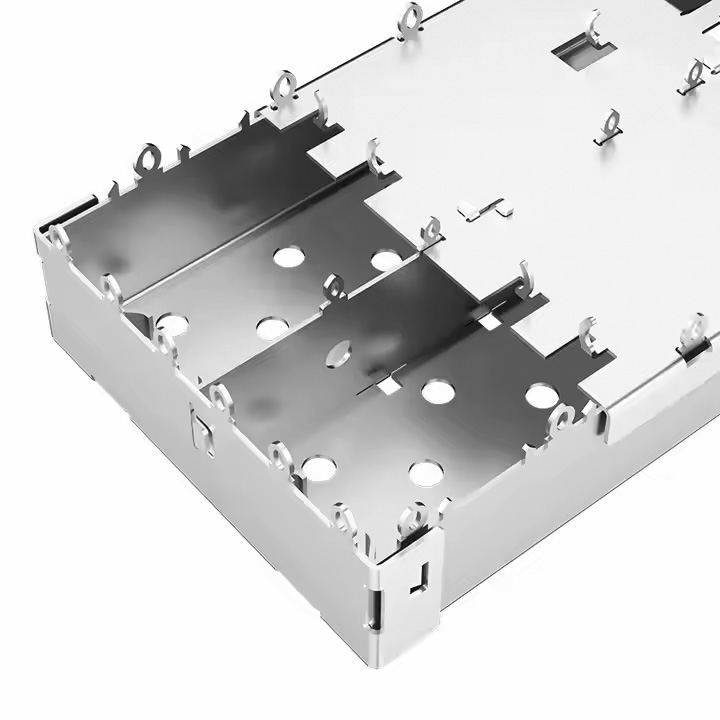
SFP cages must strictly adhere to SFF-8432 and SFF-8472 Multi-Source Agreements (MSA). Quality manufacturers build in-house progressive stamping dies that maintain key mating tolerances within ±0.03 mm. For SMT soldered cages, internal stress-relief stamping must guarantee coplanarity of solder leads to Max 0.10 mm. For press-fit versions, compliant pin dimensional consistency determines mass production yield.
1.2 Metallurgy & Electrochemical Plating Standards
Low-cost cages utilize generic phosphor bronze or stainless steel for EMI fingers, resulting in fast spring fatigue and high transfer impedance. Industrial-grade manufacturers utilize full-perimeter Beryllium Copper (BeCu) spring fingers with dense nickel underplating. The assembly must pass 48-hour to 96-hour Neutral Salt Spray (NSS) testing to prevent oxidation in harsh environments.
1.3 Thermal Management & Enclosure Form Factors
As per-port power consumption scales from 1W (1G SFP) to 3.5W (25G SFP28) and 12W+ (400G QSFP-DD), manufacturers must offer thermal options including integrated aluminum/copper heatsinks, heat-sink clips, and base-mounted conduction plates modeled through thermal simulations.
1.4 Drop-In PIN-to-PIN Replacement Library
The market has historically been dominated by Amphenol, Molex, and TE Connectivity. An eligible supplier must provide a validated cross-reference database ensuring 100% mechanical, PCB layout, and bezel cutout compatibility without requiring PCB Gerber revisions.
2. Evaluating Physical Quality: Four Measurable Engineering Metrics
2.1 High-Frequency EMI Shielding Effectiveness (SE)
Electromagnetic wavelength scales inversely with frequency ($\lambda = c / f$). At 6 GHz (the critical second and fourth harmonic range for 25G NRZ and 100G links), the half-wavelength slot resonance ($\lambda / 2$) is just 25 mm. Standard commercial cages with finger gaps of 0.3 mm to 0.5 mm act as slot antennas, leaking high-frequency noise through front-panel cutouts.
Benchmark: Premium cages feature continuous BeCu fingers with slot gaps ≤ 0.15 mm, delivering measured Shielding Effectiveness (SE) under IEC 61967 of ≥ 70 dB @ 1 GHz, ≥ 60 dB @ 3 GHz, and ≥ 50 dB @ 6 GHz.
2.2 Mechanical Insertion Force, Retention, & Endurance
According to SFP MSA specifications, module insertion and extraction forces must remain balanced to prevent latch breakage and contact plating gouging.
Benchmark: Full mating force must remain within 20 N to 30 N. The latching mechanism must withstand ≥ 500 cycles (industrial grade ≥ 1,000 cycles) without spring relaxation, latch deformation, or increased electrical contact resistance.
2.3 Press-Fit Pin Retention & PCB Plating Tolerance
Multi-port stacked configurations rely heavily on solderless press-fit (eye-of-the-needle) termination for solid mechanical grounding.
Benchmark: Single compliant pin retention force must exceed ≥ 15 N. Manufacturers must supply strict PCB layout guidelines: recommended finished hole diameter of 0.65 mm to 0.70 mm (0.68 mm preferred), Non-Plated Through Hole process with copper plating (NPTH with plated barrel), hole copper thickness ≥ 25 µm, and hole diameter tolerance within ±0.05 mm.
2.4 Thermal Dissipation Tiers
Cages must incorporate cut-off waveguide apertures that permit airflow while trapping RF emissions, structured in three thermal tiers: standard natural convection (≤ 2W per port), spring-clip base mounted (≤ 5W per port), and integrated extruded aluminum/copper fins (≤ 12W per port for QSFP-DD/OSFP) to keep optical lasers below 85°C.
3. JIAXUN Engineering Solutions & Model Case Studies
As a specialized Chinese physical-layer connectivity manufacturer, JIAXUN maintains an active cross-reference database of 440+ cage configurations. Below are three representative JIAXUN models evaluated against international counterparts:
Application: 10G SFP+ and 25G SFP28 industrial switches, edge routers, and PTZ camera controllers requiring harsh environment EMC compliance (-40°C to +85°C).
Drop-In Equivalent: 100% PIN-to-PIN equivalent to Amphenol U77-A1612-3001 and TE Connectivity 2110304-1.
- BeCu Perimeter Gasket: Stamped finger spacing controlled within ≤ 0.15 mm, achieving SE ≥ 70 dB @ 1 GHz and SE ≥ 50 dB @ 6 GHz.
- Robust Compliant Pins: Press-fit retention ≥ 15 N per pin, maintaining zero ground drift under EN 50155 industrial vibration standards.
- Zero Re-Spin Cost: Exact match for front panel bezel dimensions and PCB footprint, enabling second-source qualification without board modifications.
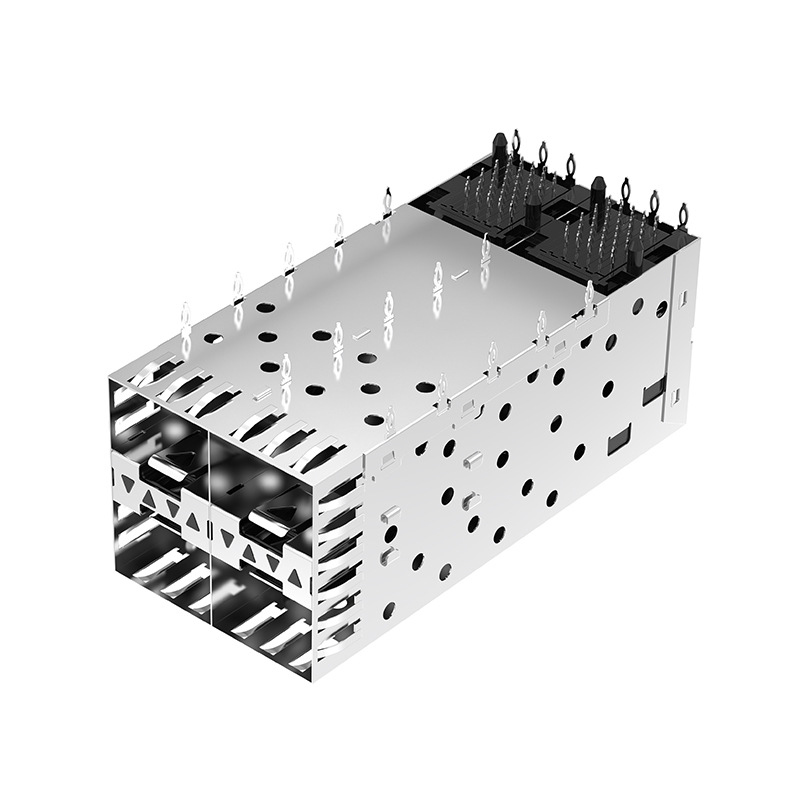
Application: High-density 1U enterprise switches, network security appliances, and carrier aggregation hardware.
Drop-In Equivalent: Direct functional and dimensional alternative to TE Connectivity 2007417-6.
- Integrated Light Pipes: Optical-grade clear polymer light pipes guide PCB surface-mount LEDs to the front panel with zero optical crosstalk.
- Inter-Port Shielding Walls: Internal metal isolation barriers prevent high-frequency RF leakage between upper, lower, and adjacent ports.
- Anti-Twist Reinforcement: Outer metal housing features stamped stiffening ribs to protect internal PCB trace layers during high-insertion-force events.
Application: AI compute clusters, high-speed Top-of-Rack (ToR) switches, and hyperscale cloud infrastructure.
Drop-In Equivalent: Direct alternative to Molex 1000163252.
- Integrated Extruded Heatsink: Deep-fin aluminum heatsink aligned with chassis airflow channels, providing thermal dissipation up to 12W per port.
- SMT Solder Coplanarity: Solder lead coplanarity verified to Max 0.10 mm via Automated Optical Inspection (AOI).
Cross-Reference Guide: Tier-1 Brands vs. JIAXUN Part Numbers
| Original OEM Part Number | Form Factor | Port Configuration | JIAXUN P/N | Technical Characteristics |
|---|---|---|---|---|
| Amphenol U77-A1612-3001 | SFP+ / SFP28 | 1x1 Single Port | JIAXUN JX11BCS2000 | BeCu fingers, gap ≤ 0.15 mm, press-fit |
| TE Connectivity 2110304-1 | SFP+ / SFP28 | 1x1 Single Port | JIAXUN JX11BCS2000 | 100% PIN-to-PIN match, identical bezel height |
| TE Connectivity 2007417-6 | SFP+ (10G/25G) | 2x2 Stacked | JIAXUN JX22BC01201 | Integrated dual-pipe LED light guides |
| Molex 1000163252 | QSFP-DD (200G/400G) | 1x3 Ganged | JIAXUN JX13FC01000E | Integrated heatsink, 12W dissipation |
| Amphenol UE36C1650005A42 | OSFP (400G/800G) | 1x1 Single Port | JIAXUN JX11GC01030M | AI data center compute cluster interconnect |
4. Vertical Integration: The Physical-Layer Architectural Advantage
Procuring optical cages, optical transceivers, and RJ45 magnetics from disparate vendors creates operational friction. When bit error rates (BER) elevate or EMC testing fails, vendors frequently disclaim responsibility:
- The transceiver supplier blames cage slot transfer impedance.
- The cage manufacturer asserts the module shell exceeds MSA mechanical envelope limits.
- The system integrator absorbs costly redesign cycles.
JIAXUN eliminates multi-vendor friction through end-to-end vertical integration:
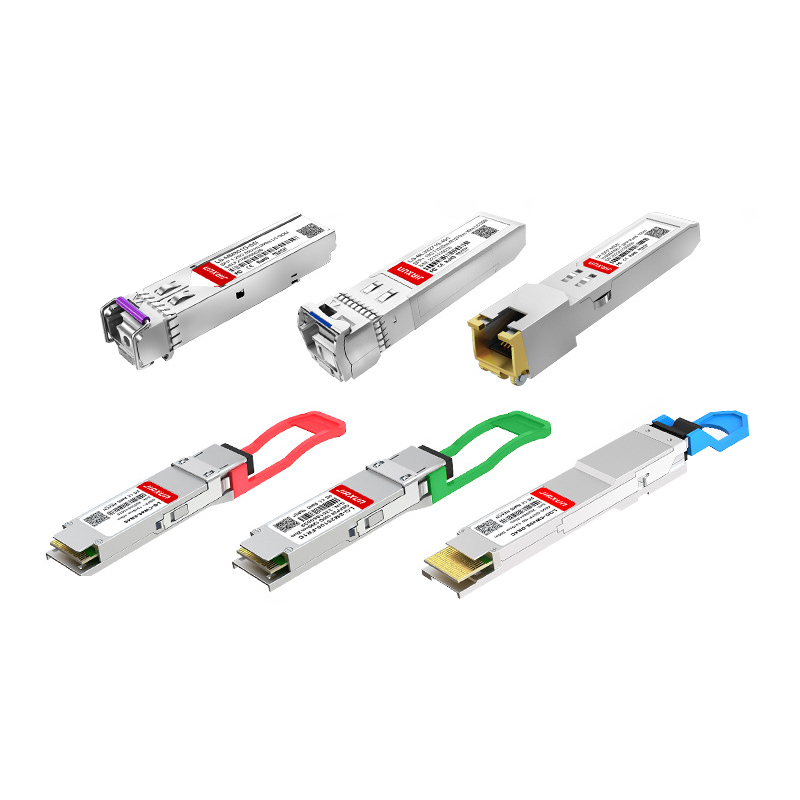
- Factory-Calibrated Mechanical Mating: JIAXUN optical cages (such as JX11BCS2000) are pre-mated and wear-tested with JIAXUN optical transceivers (such as the 1.25G JS-SM311G-10C and 25G industrial JS-SM3125-30I), guaranteeing smooth 20N to 30N insertion force and zero contact gouging.
- Dual-Layer Faraday Cage Coupling: Internal optical module shielding integrates seamlessly with the cage's BeCu spring fingers, forming a double-layer Faraday shield that eliminates cavity resonance in 1G to 400G deployments.
- Unified Engineering Accountability: Hardware designers interact with a single engineering point of contact across modular RJ45 jacks (such as JIAXUN JG00 and sunk-type JT59), LAN magnetics, optical cages, and transceivers, reducing development timelines by up to 30%.
5. Engineering Qualification Checklist: SFP Cage Sourcing
Conclusion
In high-speed, high-density hardware design, an SFP shielding cage is not merely a mechanical guide—it serves as the critical thermal conduit and electromagnetic shield for the physical layer. JIAXUN combines progressive stamping precision, a verified 440+ OEM replacement catalog, and full vertical integration across copper and optical interconnects, providing hardware engineers worldwide with reliable, drop-in connectivity solutions.
Request JIAXUN SFP Cage 3D STEP Models & Engineering Samples
Access the complete 440+ part cross-reference catalog, download mechanical CAD files, or contact the JIAXUN engineering team for free evaluation samples.
Contact Engineering Team
SFP Cage & Connector: The Complete Guide for High-Speed Network Hardware Design