PoE vs Non-PoE Magnetic RJ45 Jacks: Selecting the Right Connector for Your Application
Executive Summary
The choice between PoE (Power over Ethernet) and non-PoE RJ45 jacks with integrated magnetics is a critical design decision that impacts the performance, cost, and reliability of your networked device. This comprehensive guide delves into the technical distinctions, application scenarios, and design considerations for both types of connectors. Understanding these differences is paramount for engineers designing industrial equipment, IoT devices, network switches, and any system relying on Ethernet connectivity. We will explore the underlying technology of integrated magnetics, the additional demands placed by PoE, and provide a structured framework to guide your selection process, ensuring optimal signal integrity, power delivery, and compliance with relevant IEEE standards.
1. Understanding the Core Technology: What Are RJ45 Jacks with Integrated Magnetics?
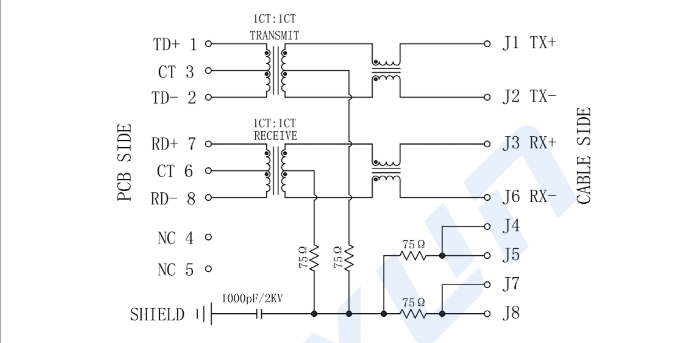
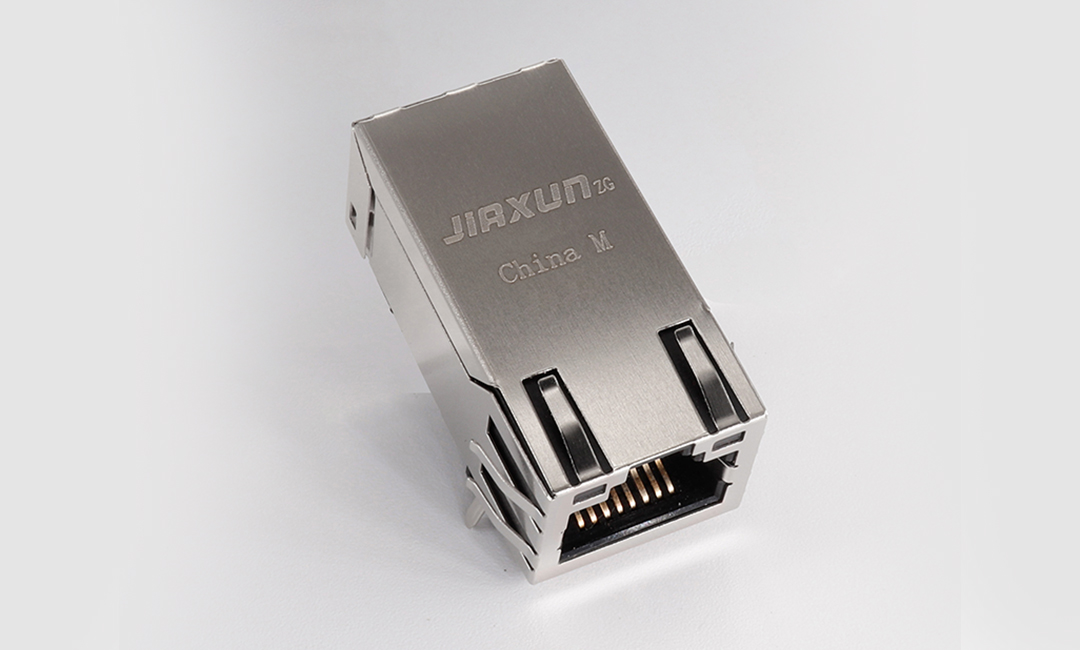
Before dissecting the PoE versus non-PoE dichotomy, it's essential to understand the fundamental role of RJ45 jacks with integrated magnetics. An RJ45 jack is more than just a physical port for an 8P8C connector. The "integrated magnetics" component is a miniaturized transformer and common-mode choke (CMC) module built directly into the jack assembly.
Why are these magnetics necessary?
They perform several indispensable functions:
-
Signal Coupling & Isolation: The transformers electrically isolate the sensitive PHY (Physical Layer) chip on your PCB from the external Ethernet cable, which can carry dangerous voltage surges from electrostatic discharge (ESD), lightning-induced spikes, or ground potential differences between devices. This isolation protects your main system from damage.
-
Common-Mode Noise Rejection: The CMC suppresses electromagnetic interference (EMI) and radio-frequency interference (RFI), which can degrade signal integrity. It does this by choking common-mode noise while allowing the differential data signals to pass through unimpeded.
-
Impedance Matching: They help maintain a consistent characteristic impedance (100Ω for Ethernet), which is crucial for preventing signal reflections that cause data errors, especially in high-speed applications.
-
Signal Conditioning: They ensure the signals meet the amplitude and waveform specifications required by the IEEE 802.3 standard for Ethernet.
Integrating these magnetics directly into the jack simplifies PCB design, reduces the board space required, improves reliability by minimizing the number of solder joints, and ensures the magnetic components are perfectly matched to the connector.

2. The Critical Divide: PoE vs. Non-PoE RJ45 Connectors
The fundamental difference between a standard RJ45 jack with integrated magnetics and one designed for PoE boils down to one thing: the ability to handle both data and significant DC power simultaneously.
2.1 Non-PoE RJ45 Jacks with Integrated Magnetics
-
Primary Function: Transmit data only.
-
Power Handling: These jacks are designed for the minimal power required for data transmission. They are not rated or constructed to handle the substantial DC current (up to 600mA per pair under IEEE 802.3bt) used in PoE applications.
-
Internal Construction: The magnetics are optimized purely for signal integrity. The transformer windings use finer gauge wire sufficient for data signals but unsuitable for high current.
-
Typical Applications: Standard network interface cards (NICs), consumer-grade routers and switches, laptops, and any device that will not be powered via its Ethernet port.
2.2 PoE-Rated RJ45 Jacks with Integrated Magnetics
-
Primary Function: Transmit data and deliver DC power.
-
Power Handling: These are specifically engineered to manage the heat and electrical stress associated with delivering power. They are certified to meet specific PoE standards (IEEE 802.3af, at, bt).
-
Internal Construction: This is where the key differences lie:
-
Heavier-Gauge Windings: The transformers use thicker wire in their windings to carry the PoE current without overheating, which minimizes resistive (I²R) power losses and prevents thermal failure.
-
Enhanced Isolation: They must provide reinforced isolation between the data and power sections to withstand higher working voltages (up to 57V DC).
-
Thermal Management: The design often incorporates features to dissipate heat more effectively, as power delivery generates heat within the jack itself.
-
DC Resistance (DCR) Rating: This is a critical spec for PoE jacks. A lower DCR in the transformer windings means less voltage drop and higher efficiency power delivery to the Powered Device (PD). Designers must check that the jack's DCR meets the requirements of their target PoE standard.
-
3. How to Choose: A Designer's Decision Matrix
Selecting the right integrated magnetic RJ45 connector is not arbitrary. Use this framework to guide your decision.
| Design Consideration | PoE RJ45 Jack | Non-PoE RJ45 Jack |
|---|---|---|
| Application Power Needs | Required if your device needs to receive or deliver power over Ethernet (e.g., IP cameras, VoIP phones, access points, IoT sensors). | Sufficient if the device has its own power source and only requires data connectivity. |
| Thermal Management | Critical. Must account for heat generation from power delivery. PCB layout and airflow are important. | Less Critical. Heat generation is minimal, related only to data transmission. |
| Cost | Higher. Due to more robust materials (thicker copper wire), enhanced construction, and required certifications. | Lower. A cost-effective solution for data-only applications. |
| PCB Real Estate | Similar footprint, but the PoE circuitry (PD controller, PSE controller) requires additional space. | Only the connector and typical PHY-related components are needed. |
| Complexity | Higher. Requires a full PoE subsystem: either a Powered Device (PD) controller or Power Sourcing Equipment (PSE) controller IC alongside the jack. | Lower. The jack connects directly to the Ethernet PHY with minimal external components. |
| Standard Compliance | Must comply with a PoE standard (e.g., IEEE 802.3af/at/bt). | Complies with data standards (e.g., IEEE 802.3ab for Gigabit Ethernet). |
Key Question for Your Project: Will this device be powered by, or provide power to, another device via the Ethernet cable? If the answer is "yes" or "maybe in the future," you must select a PoE-rated jack. Using a non-PoE jack in a PoE application is a common and catastrophic design error that will lead to connector failure due to overheating, potentially causing a fire hazard.

4. Design and Layout Best Practices for Integrated Magnetic Jacks
Whether you choose a PoE or non-PoE variant, proper implementation is key to performance.
-
Follow the Datasheet: The manufacturer's datasheet is your blueprint. It provides a recommended landing pattern, critical keep-out zones, and guidance on the placement of termination resistors and capacitors.
-
Minimize Trace Length: Keep the differential pairs between the PHY and the RJ45 connector with magnetics as short, direct, and symmetric as possible. Avoid vias and 90-degree bends on these traces.
-
Maintain Impedance: Ensure your differential pairs are routed as controlled impedance traces at 100Ω.
-
Solid Ground Plane: Provide an uninterrupted ground plane beneath the connector and the magnetics to shield against noise and provide a stable return path.
-
PoE-Specific Considerations:
-
Trace Width: For the power-carrying traces from the PD controller to the jack, use a width appropriate for the current (e.g., 24-30 mil for 1A current).
-
Isolation: Maintain creepage and clearance distances as specified by the PoE standard and your safety requirements.
-
5. Frequently Asked Questions (FAQ)
Q1: Can I use a non-PoE RJ45 jack with integrated magnetics in a PoE application if the current is low?
A: Absolutely not. This is a serious safety risk. Non-PoE jacks are not constructed with the necessary wire gauge to handle PoE currents. They will overheat, potentially desolder themselves, melt, or cause a fire. Always use a jack explicitly rated for the PoE standard you are implementing.
Q2: Are all PoE-rated jacks the same?
A: No. They are rated for different levels of power. A jack designed for IEEE 802.3af (15.4W) may not be suitable for IEEE 802.3bt Type 4 (90W). Always check the jack's specifications against the maximum power your design requires.
Q3: How does the "integrated magnetics" part affect EMI/EMC testing?
A: Properly functioning integrated magnetics are crucial for passing EMI/EMC tests. The common-mode choke suppresses noise emitted from the cable (radiated emissions) and protects the system from noise coming in (immunity). Using a jack without magnetics or with poorly designed magnetics will almost certainly lead to test failure.
Q4: What is the difference between a shielded and an unshielded RJ45 jack with magnetics?
A: A shielded (or metal-bodied) jack provides superior protection against external EMI/RFI and also prevents the device itself from emitting noise. It must be connected to the chassis ground via a low-impedance connection. Use shielded jacks in industrially noisy environments or for products that must meet stringent emission standards. Unshielded jacks are suitable for benign, consumer-grade environments.
Q5: My device doesn't use PoE now, but might in a future version. What should I do?
A: For future-proofing, it is often wise to use PoE-rated RJ45 jacks with integrated magnetics and simply not populate the PD controller circuit. The BOM cost increase for the jack itself is marginal compared to the cost of a full board respin later. This gives you the flexibility to add PoE functionality with a simple PCB revision.
Partnering with a Trusted Supplier: Jiaxun Intelligent Tech
Navigating the complexities of component selection and ensuring a reliable supply chain is as critical as the design itself. For engineers and procurement specialists seeking high-quality, reliable RJ45 jacks with integrated magnetics, Jiaxun Intelligent Tech emerges as a trusted partner.
Jiaxun Intelligent Tech specializes in the research, development, and manufacturing of advanced connectivity solutions, with a deep expertise in magnetic RJ45 connectors for both commercial and demanding industrial applications. Their product portfolio is engineered to meet rigorous international standards, ensuring performance and reliability.
Why Consider Jiaxun Intelligent Tech for Your Next Project?
-
Comprehensive Product Range: They offer a wide array of RJ45 jacks with integrated magnetics, including both PoE and non-PoE variants, in various pin configurations (through-hole, SMT), port counts (single, dual, stacked), and shielding options (shielded vs. unshielded) to fit any design constraint.
-
Focus on Quality and Reliability: Their connectors are built to last, featuring robust construction, high-temperature resistant plastics, and gold-plated contacts for superior corrosion resistance and stable connectivity.
-
Technical Expertise: Their team possesses deep technical knowledge and can provide valuable support during your design-in phase, helping you select the optimal connector for your specific performance, thermal, and spatial requirements.
-
Supply Chain Stability: In an era of component shortages, Jiaxun Intelligent Tech demonstrates a strong commitment to manufacturing stability and consistent delivery, helping you avoid production delays.
For your next design requiring robust Ethernet connectivity, evaluating the components from Jiaxun Intelligent Tech is a step towards ensuring product performance, safety, and long-term market availability.
Understanding T568A and T568B Wiring Conventions for RJ45: A Comprehensive Guide
Magnetic RJ45 Jack Complete Guide: Specifications, Applications, and Supplier Selection